Deposit availability does not guarantee a matching withdrawal route, and fees, conversion and processing times can affect the amount received.

A payment option has at least two separate terms: whether it can put money into an account and whether it can return money from that account. The labels may look like two ends of one transaction, but the available routes need not match. A method shown beside a deposit field is evidence only of a possible deposit route, not of a corresponding cashout route.
That distinction matters more than the number of logos on a cashier page. An online casino payment solution can be presented as simple at the point of loading funds while leaving the exit route subject to different conditions. The relevant comparison is therefore not just between payment brands. It is between the stated terms for money going in and the terms for money coming out.
A specialist review reports that PayID deposit availability depends on the operator and that withdrawal support needs to be checked separately. That is a useful illustration of why a familiar payment name does not settle both questions. The method may appear in one part of a cashier without being specified for the other. The conclusion should stay narrow: a listed deposit option does not establish that the same option is available for withdrawals.
Choosing a casino payment method means checking more than how you can deposit: minimums and withdrawal speeds can also matter. This list highlights the payment-related details available for each operator, alongside licensing information where provided.
Roby Casino
Roby Casino is listed as licensed by Curaçao eGaming under Roby Games Ltd. No deposit or payout details are provided here.
Playfina Casino
Playfina Casino is listed under a Curaçao eGaming licence held by Hollycorn N.V. since 2017. Its minimum deposit is A$20–30, depending on the offer.
WinSpirit Casino
WinSpirit Casino is listed under Curaçao eGaming licence OGL/2024/923/0383, issued to Antillephone N.V. Its minimum deposit is A$30.
Lucky Dreams
Lucky Dreams lists a A$20 minimum deposit with POLi. It is also listed as licensed in Curaçao.
Bizzo Casino
Bizzo Casino is listed as licensed by the Curaçao Gaming Control Board, with TechSolutions Group N.V. named as the operator. No deposit or payout details are provided here.
House of Pokies
House of Pokies lists PayID payouts in 1–24 hours and a A$30 minimum deposit, with PayID deposits from A$10. Its licence is described as an international iGaming licence, but the jurisdiction is not named.
7Bit Casino
7Bit Casino is listed as operating under a Curaçao licence, with Dama N.V. named as the operator. No deposit or payout details are provided here.
Golden Pokies
Golden Pokies is listed as licensed in Curaçao. No deposit or payout details are provided here.
SkyCrown
SkyCrown lists crypto payouts at about 10–15 minutes and fiat payouts at 1–5 days, with a A$30 minimum deposit. It is listed as licensed by the Tobique Gaming Commission.
Ricky Casino
Ricky Casino lists crypto payouts in under an hour and PayID payouts in 1–3 business days. Its minimum deposit is A$20, or A$30 to qualify for the bonus.
Promotions add another layer. A no-deposit offer may still carry wagering, verification and withdrawal conditions. Receiving promotional credit, or seeing a balance displayed, does not by itself establish that the balance can be withdrawn. The amount that matters financially is the amount eligible for payment after the applicable conditions have been met, not the headline value attached to the offer.
This is a terms issue, not a judgement about whether a promotion looks generous. The promotional description and the withdrawal rules answer different questions. One describes what may be credited; the other determines what may leave the account and under what conditions. If those terms are not read together, the displayed balance can be mistaken for money already available to cash out. That is a poor accounting method, even when the interface encourages it.
Payment pages can also describe a method in language that makes it sound broader than the stated function. A specialist review describes Apple Pay deposits as using a phone’s digital wallet and biometric authentication. That explains how a deposit may be authorised; it does not establish Apple Pay as a withdrawal route. A phone payment casino label, or a prominent wallet icon, should not be treated as proof of a complete in-and-out payment arrangement.
The practical unit of comparison is thus a route with its conditions attached: the permitted direction, any promotion-related requirements and the status of the amount shown for withdrawal. A payment method name without those details is incomplete information. The same applies to broad labels such as casino payment options or online casino payment solutions. They can group very different arrangements together while concealing the question that determines the eventual cash value.
There is also a legal boundary that payment terminology cannot change. Under the Interactive Gambling Act 2001, operators cannot provide real-money online casino games to people physically located in Australia. A payment method, a promotional balance or an apparently available cashier route does not alter that restriction. Describing a route is not an endorsement of using it.
The defensible reading is straightforward: deposit availability, cashout availability and promotional eligibility are separate terms. None should be inferred from another. A payment option is not a complete payment arrangement until its direction and applicable withdrawal conditions are clear.
A payment record can show money entering an account without establishing how, or whether, an equivalent amount can leave it. A specialist review describes casino payment methods as potentially different for deposits and withdrawals. That distinction is about the transaction arrangement, not merely the label shown beside a payment button: the accepted route, account status and conditions attached to funds can all affect the amount ultimately available for withdrawal.
The deposit is an incoming transaction. The account may display the amount credited, but that figure is not necessarily the same as the amount eligible for cashout. A promotion can add funds to the displayed balance while attaching conditions to some or all of that balance. The relevant calculation is therefore not simply “amount deposited plus bonus”. It is the portion that remains withdrawable after the applicable terms have been met.
No-deposit promotions illustrate the difference particularly clearly. “No deposit” describes how the promotional credit is issued; it does not mean that the credit is unrestricted or automatically payable as cash. Wagering conditions may apply before any associated winnings can be withdrawn. Verification requirements may also need to be completed, and withdrawal conditions may specify what happens once a cashout is requested. Until those requirements are satisfied, a balance shown on screen can be larger than the amount that can actually be paid out.
A useful way to read any promotional balance is to separate three figures: the cash deposited, the promotional credit, and the amount currently eligible for withdrawal. Those figures may not match. If a condition applies only to promotional funds, the cash portion may be treated differently from the bonus portion. If the terms combine them, the combined balance may be subject to a condition before any withdrawal is permitted. The wording, rather than the headline value of the offer, determines which calculation applies.
The same care is needed when comparing incoming and outgoing arrangements. A method presented for adding funds does not, by itself, confirm that the same method is available for receiving a payment. Nor does a successful deposit establish that the account has passed verification or that promotional conditions have been cleared. The deposit confirms only that an incoming transaction was accepted at that point. It does not settle the later cashout question.
For sound casino payment risk management, the transaction should be assessed as a complete sequence: what is credited, which terms attach to it, what must happen before it becomes withdrawable, and which payment arrangements govern the outgoing transaction. Each part changes the practical value of an offer. A generous-looking credit can have little immediate cash value if its conditions remain unmet; a smaller balance may be more useful if it is already eligible for withdrawal. The headline amount is packaging. Eligibility is the accounting.
These distinctions are informational, not an invitation to transact. Under Australia’s Interactive Gambling Act 2001, providing real-money online casino games to people physically located in Australia is illegal for operators. An offer or payment screen does not alter that legal position. Where promotional terms are encountered in material about offshore services, the figures displayed should not be treated as proof that funds can lawfully be withdrawn or that the service is available as a compliant option in Australia.
Payment availability in Australia has to be read against two separate facts: what a payment service supports and what an online gambling operator is legally permitted to offer. A method appearing on an offshore site’s cashier page does not make the service lawful in Australia. Under the Interactive Gambling Act 2001, providing real-money online casino games to people physically located in Australia is illegal for operators. Casino-style games such as slots, poker, blackjack and roulette fall within that prohibition.
PayID is a locally established bank-payment service: every major Australian bank supports it. That tells something about its reach across the domestic banking system, not about whether a particular gambling transaction will be accepted. An operator’s payment page describes its own arrangement; it cannot override the law applying to the service or establish that the arrangement is suitable for Australian residents.
A specialist review describes PayID as the primary Australian-dollar deposit method accepted by most offshore operators. That is a time-sensitive account of operator offerings, not a guarantee of present availability across the market. Individual sites can change their listed methods, and the mere presence of PayID does not establish that a casino-style service is lawful to provide in Australia. The distinction matters: a familiar bank-linked option can make an offshore cashier look locally integrated without changing the operator’s legal position.
PayPal has a different status. It has explicitly prohibited gambling transactions in Australia since 2021. Its availability for ordinary payments should therefore not be mistaken for permission to use it for gambling transactions. A payment brand’s general presence in a country and its policy on a particular transaction category are separate questions.
The same separation applies when comparing Australian casino payment methods in broad terms. A list of brands or logos on a cashier page is not a statement of Australian regulatory approval. It indicates, at most, what the operator claims to accept. It does not establish that the service is permitted, that the payment will be processed, or that the account holder has any particular protection under Australian law. Those are different issues, and a payment interface does not settle them.
This also limits what can be inferred from terms such as “local”, “Australian-dollar” or “bank supported”. PayID’s support by major Australian banks is a fact about the payment network’s domestic reach. It is not evidence that an offshore casino is an Australian-authorised service. Likewise, a service’s refusal to handle a category of transaction cannot be overcome by choosing a different display currency or payment route.
For the Australian market, payment information is therefore contextual rather than an endorsement. PayID’s broad bank support explains why it appears in discussions of local payment access; the specialist-review claim about offshore adoption remains a report of changing operator practice. PayPal’s gambling restriction, by contrast, is explicit and has applied since 2021. None of these details changes the central legal distinction: real-money online casino services are prohibited when supplied to people in Australia. A payment method can be familiar, widely supported for ordinary banking, or listed by an offshore site, while the underlying gambling service remains unlawful for the operator to provide.
A payment method shown at checkout is not proof that a transaction will be accepted. The casino payment gateway presents a route for submitting a payment, but approval also depends on whether the transaction can proceed through the relevant financial institution. A visible Visa or Mastercard option therefore describes what the checkout offers, not a confirmed outcome.
A specialist review describes Visa and Mastercard deposits as instant when they are accepted. That timing does not resolve the more important question for an Australian cardholder: whether the transaction will be authorised at all. A specialist review also reports that many Australian financial institutions now block standard Visa and Mastercard transactions to offshore casinos. The two statements are compatible. An accepted card payment may be instant; a blocked one does not become successful because the payment page lists the card brand.
This is the practical gap between casino payment technology and payment acceptance. The gateway can display a method while the financial institution prevents the transaction from proceeding. In that situation, the presence of a card logo is not evidence that the route is usable, and the quoted processing speed has no bearing on the result. A fast route that cannot be accepted has no transactional value.
The legal setting matters too. Under the Interactive Gambling Act 2001, operators are prohibited from providing real-money online casino games to people physically located in Australia. A payment interface does not change that position. This is not a recommendation to find a different way around a declined card payment; card acceptance is only one part of a service that operators are not permitted to provide to customers in Australia.
Searches for other checkout labels, including Apple Pay, Google Pay or Klarna, do not answer the same question. A digital wallet or another payment label appearing in a payment gateway would not establish that the underlying transaction is accepted, nor would it make an offshore casino service lawful. The relevant distinction is between an option displayed by a payment page and an actual, permissible transaction.
For an accurate assessment of a payment route, the operator’s displayed options alone are insufficient. The card’s appearance in a list should not be read as confirmation of approval, and an advertised instant deposit time should be understood as conditional on acceptance. Where Australian financial institutions block many standard card transactions to offshore casinos, the displayed route and the usable route can differ. The checkout can show the door; that is not the same as the transaction being allowed through it.
BPAY is a bank-payment option with a settlement delay, not a route suited to immediate access to funds. A specialist review reports that BPAY payments take one to two business days. That interval matters: submitting a payment and having it reflected in an account are separate events, so a transaction initiated on BPAY should not be treated as available for real-time play.
A specialist review also characterises BPAY as a backup when PayID is unavailable, rather than a common choice for real-time gameplay. This makes its role conditional. It may appear among the payment systems offered by a site, but that listing alone does not make it an immediate option or establish when funds will be credited. The stated settlement window is the relevant cost in time.
A fast, bank-linked route used as the primary Australian-dollar deposit method by many offshore operators.
A bank-payment option with a settlement delay of one to two business days, often used as a backup.
The distinction is practical rather than cosmetic. A fast bank-linked route and BPAY may both draw on a bank account, yet they should not be treated as equivalent when timing is the priority. With BPAY, the reported one-to-two-business-day period makes it unsuitable for a transaction that depends on funds arriving at once. It is a fallback, not a substitute with the same timing.
Payment information should also be read narrowly. A reference to BPAY describes a payment route; it does not establish that a particular transaction will be accepted, or that a service offering it is lawful in Australia. Under the Interactive Gambling Act 2001, real-money online casino games provided to people in Australia are prohibited services. A payment method does not alter that position.
The same restraint applies to labels such as “safe casino payment methods.” A familiar payment system is not, by itself, evidence that an online casino service is permitted or that funds are protected. The payment route answers only how a transaction might be made. It does not settle the legal status of the underlying service.
For a timing comparison, the useful points are therefore limited: BPAY is described in specialist material as a backup when PayID is unavailable, and its reported payment window is one to two business days. Anything faster should not be assumed from the fact that BPAY is displayed alongside other methods. A delayed settlement is still a delayed settlement, however familiar the payment name.
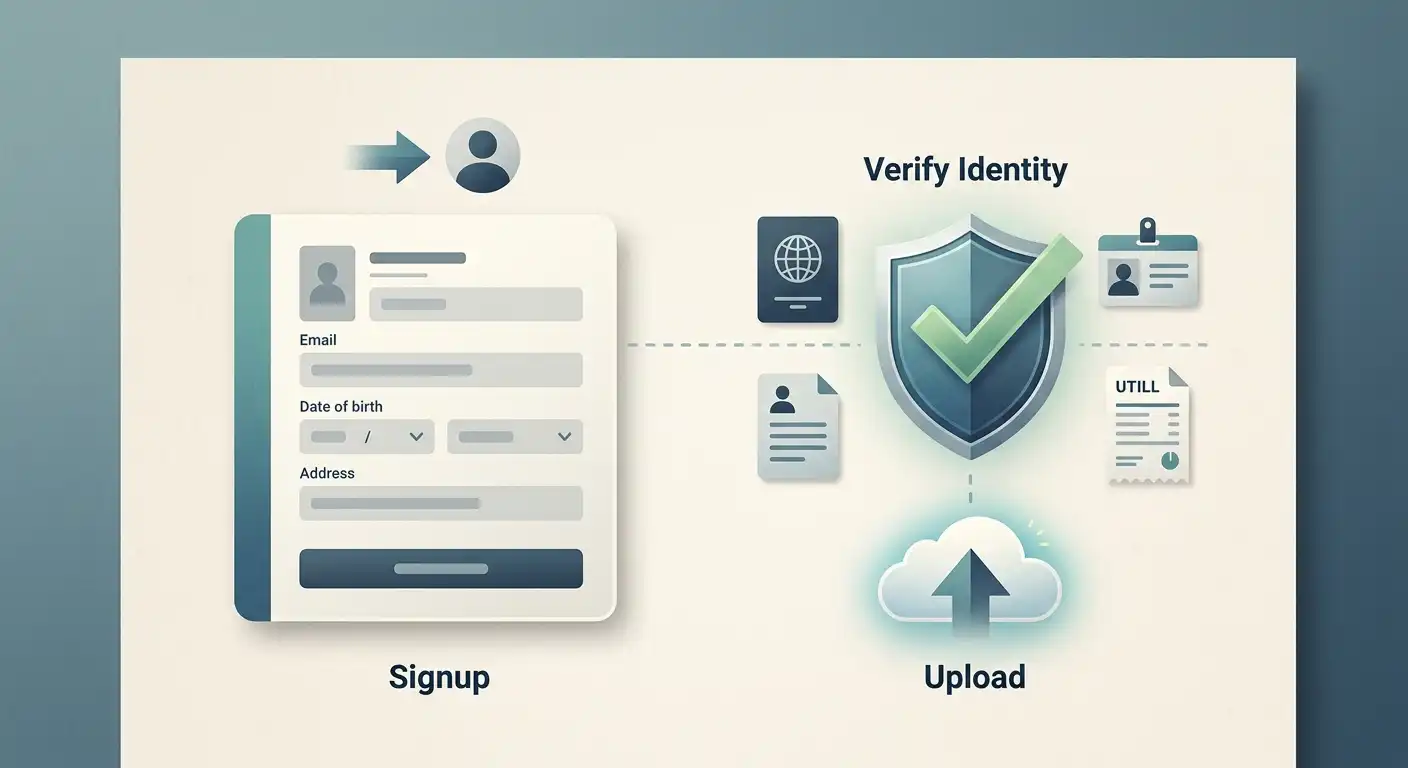
A withdrawal request starts a separate review, not an automatic reversal of the deposit. The casino may ask for government-issued identification, proof of address dated within three months and evidence that the payment method belongs to the account holder. A specialist review describes these as possible verification requirements; the exact documents depend on the operator’s process. Until the checks are complete, a request can remain pending even if the account balance is visible.
The payment route matters as well. A method shown in a casino payment portal does not, by itself, confirm that it can receive a withdrawal. The cashout method, any required account-name match and the steps needed to verify ownership should be established before money is deposited. A payment platform can process the incoming side while leaving the outgoing route subject to different conditions.
Bank transfer is a practical option for a large cashout, but its timing may be determined by the casino’s internal handling rather than by the bank alone. A specialist review reports that some casino bank transfers are processed manually once or twice a week. On that schedule, a request submitted on Friday could arrive by Wednesday. That is a reported example, not a universal timetable: weekends, review queues and the operator’s processing schedule can all affect when funds are released.
The same specialist review characterises bank transfer as slow but suitable for withdrawals above $10,000. That makes it a route to assess for a substantial balance, not a promise of a particular arrival date. The important distinction is between approval and receipt: completing a withdrawal form does not mean the request has passed identity checks or been sent to the bank.
Fees change the net amount. The review reports that casinos often apply a flat bank-transfer charge of $5–$15. If that charge applies, the amount received is lower than the amount approved for withdrawal. The fee should be checked alongside the processing schedule and any account conditions; a seemingly straightforward cashout can have both a wait and a fixed deduction.
For comparison, the same review describes crypto withdrawals as usually free, but that does not make them interchangeable with a bank transfer or suitable for every account. Each route has its own eligibility and handling terms. This is not a recommendation to use cryptocurrency; it is a reminder that a fee comparison alone does not establish whether a withdrawal method is available or appropriate.
The useful comparison is therefore the amount that can actually reach the intended account, after verification, processing and stated charges. For any casino payment method, the deposit screen is not a cashout confirmation. Withdrawal availability and the applicable checks need to be confirmed before depositing, with the payment route and its conditions recorded as part of the decision.
A payment route has a gross amount and a received amount. Fees and exchange rates sit between them, so the method with the lowest visible charge is not necessarily the one that leaves the highest balance after a withdrawal.
A specialist review reports that Skrill withdrawals to a bank take 1–2 days, with some casinos applying a transaction fee of 1–3%. The fee reduces the amount arriving in the bank account; the stated processing time does not include any separate delay imposed by the receiving bank. Because the fee is not described as universal, it needs to be checked against the relevant provider and transaction terms rather than treated as a standard Skrill charge.
Currency conversion can create a separate deduction. Converting AUD to EUR can cost 2–4%, depending on the terms applied. Where an account or payment route uses euros, the amount shown before conversion may therefore differ from the AUD value ultimately received. A comparison should account for both the conversion cost and any transaction fee, rather than treating the displayed withdrawal amount as the net result.
The calculation is straightforward: start with the amount being converted, subtract the applicable conversion cost, then subtract any fee charged on the resulting transaction. If the provider applies the fee at a different stage, the final figure will differ; the order and basis of calculation should be visible in the terms. Small percentages are still deductions from the same balance, not separate administrative details.
Neteller presents a different cost point. A specialist review states that credit-card funding carries a 1.45% charge. That figure concerns funding a Neteller account by credit card; it is not a recommendation to use a credit card for online gambling. Credit-card payments must not be used to fund online wagering. Any fee information is only relevant where the funding method itself is lawful and permitted for the transaction.
Net Amount Calculation
Currency Conversion
Start with the amount being converted and subtract the applicable conversion cost (e.g., 2–4% for AUD to EUR).
Transaction Fee
Subtract any transaction fee charged by the provider (e.g., 1–3% for some Skrill bank withdrawals) from the resulting amount.
Final Total
Determine the final net amount that actually reaches the intended account.
These charges belong to the provider layer of casino payment processing, not just the casino’s cashier. A casino payment provider may set its own funding or withdrawal costs, while currency conversion can be applied by another party in the chain. The relevant comparison is therefore the net amount after all stated deductions—not a headline claim that a route is free or quick.
For online casino payment providers, the practical distinction is between a fee attached to a specific transaction and a conversion cost attached to the currency exchange. Skrill’s reported bank-withdrawal window is 1–2 days, but timing does not offset a percentage charge. The transaction’s final value depends on the fee terms and the currency received; those are separate parts of the calculation.
A withdrawal’s advertised speed describes the payment rail, not a guaranteed arrival time. A specialist review reported that MuchBetter withdrawals were faster than traditional bank transfers, which could take as long as five days. That comparison is useful for understanding the stated timing, but it does not establish a fixed completion time for every transaction.
Cryptocurrency withdrawals have a different source of delay: blockchain confirmation. A specialist review put Litecoin processing at about 10 minutes, while Bitcoin could take as long as an hour when its network was congested. Those figures are reported estimates, not service commitments. Network conditions can change, so a quoted time should not be treated as a deadline for funds to arrive.
The distinction matters when comparing a fast payment rail with an instant payment claim. A method may process a transfer quickly under the conditions described, but that does not make every withdrawal instant. MuchBetter and cryptocurrency also involve different cost considerations: blockchain transfers can carry network fees, and Ethereum gas fees may reduce the amount ultimately received. The relevant comparison is therefore the net amount after fees, not speed alone.
Blockchain transactions are irreversible once sent and have no chargeback option. An incorrect address or other transfer error cannot be handled like a disputed card payment. The final destination and amount therefore need to be checked before confirming a transfer; speed offers no remedy after an irreversible transaction.
For an Australian reader assessing payment information, these details are descriptive rather than an endorsement of offshore casino services. Online casino-style games offered for real money to people in Australia are prohibited under the Interactive Gambling Act 2001. A payment method’s presence in an operator’s cashier does not alter that position.
The practical comparison is narrow: MuchBetter was reported as faster than traditional bank transfers, while crypto timing varied by coin and network congestion. Fees and irreversibility belong in the same calculation as speed. A short processing estimate is not the same as certainty about arrival, and a fast rail can still deliver a lower net amount or leave no route to reverse an error.
A prepaid voucher sets a clear ceiling on what can be loaded: spending cannot exceed the value placed on the voucher. That makes the payment itself easy to bound. It does not, however, determine how any resulting balance could be paid out. The deposit instrument and the cashout route are separate parts of the arrangement.
Prepaid vouchers act as a one-way funding method. While they set a clear ceiling on the amount loaded, they are generally unavailable for withdrawals back to the same voucher.
A specialist payment review describes voucher deposits as generally unavailable for withdrawal back to the same voucher. In practical terms, a voucher can serve as a one-way funding method while a different route is needed for a withdrawal. Treating the voucher’s accepted status as proof of a matching payout option would confuse two distinct functions.
That distinction matters before any money is committed. The relevant terms are not merely whether a voucher appears among deposit choices, but whether an authorised withdrawal method is available and what conditions apply to it. If no acceptable route has been established, the voucher’s spending cap does not solve the cashout problem. It only limits the amount initially loaded.
Prepaid vouchers can therefore control the amount exposed at the payment stage, but they do not make funds withdrawable to the voucher. The practical value of the cap depends on the wider transaction terms: a bounded deposit is not the same as a bounded, recoverable balance. Payment interfaces can make the first step look complete while leaving the second unresolved.
Australian law also sets a boundary around the context in which these payment arrangements are discussed. The Interactive Gambling Act 2001 prohibits operators from providing real-money online casino games to people in Australia. A payment option’s appearance on a website does not change that legal position or establish that the service may lawfully be provided locally.
For a payment-method comparison, vouchers should be assessed narrowly: they cap the amount loaded, while the withdrawal route must be considered separately. Neither the presence of a voucher option nor its spending limit confirms that winnings or unused funds can be returned through it. A deposit method is not, by itself, a cashout plan.
PayID is a bank-account identifier, not a separate balance stored on a phone. It can link a mobile number, email address or Australian Business Number (ABN) to an Australian bank account through the New Payments Platform. The phone may provide the identifier, but the underlying funds remain associated with the linked account.
That distinction matters when a payment screen presents a mobile casino payment as if it worked like a digital wallet. PayID does not, by itself, hold money for later use or create a separate pool of funds. It provides a way to identify the bank account connected to the chosen PayID. A casino payment page displaying PayID therefore does not establish that the service is a wallet, or that a payment will be available for every account or purpose.
A mobile number is only one possible identifier. An email address or ABN can serve the same linking role, so “PayID on mobile” describes the identifier or device involved, not a distinct mobile payment product. Nor does using a phone change the underlying payment rail: the link is to an Australian bank account through the New Payments Platform.
For a casino with mobile payment options, the label alone says little about what happens to the money. A bank-linked payment should not be treated as equivalent to paying via a voucher, where the loaded amount sets a spending cap, or to a wallet that maintains its own balance. The relevant distinction is where the funds are held and what account the identifier points to.
The appearance of PayID on an online casino payment page also does not establish that the operator can lawfully provide real-money casino games in Australia. The Interactive Gambling Act 2001 prohibits operators from providing those services to people physically located in Australia. Payment technology does not alter that legal position.
PayID is therefore best understood as a convenient identifier for a bank account, not as an independent store of value. Any payment-page label describes a claimed route, not a new type of account or a change to the legal status of the service.
Yes, fees can apply: bank transfers may carry a flat $5–$15 charge, and some casinos charge 1–3% for Skrill withdrawals. Currency conversion from AUD to EUR can add 2–4%, while crypto withdrawals are usually free.
For fast, low-fee withdrawals, Litecoin is a strong option: withdrawals typically take 10–30 minutes and have low fees. Check the casino’s terms, because deposit and withdrawal methods may differ.
Casinos may require verification before processing a withdrawal. Be ready to provide government-issued ID, proof of address dated within three months, and proof of your payment method.
MuchBetter withdrawals are faster than traditional bank-transfer cashouts, which can take up to five days. Bank transfers may also be processed manually only once or twice a week.
Written by the editors at Norco Casino.