A cryptocurrency transaction may move quickly, while recognition by the recipient and availability in an account remain separate steps.

A cryptocurrency transfer can be described as near-instant, but that phrase concerns the movement of the transaction, not necessarily the time from initiating a deposit to seeing a usable balance. A specialist review characterises cryptocurrency transactions as capable of near-instant movement. That is a possibility, not a guaranteed arrival time for every transfer or a promise about how a particular service will handle it.
For Bitcoin deposits, the useful distinction is between the transfer itself and the recipient’s treatment of it. A fast-moving transaction does not, on its own, establish when a receiving service will recognise the deposit or make the balance available. Those are separate stages. The transfer-speed claim should therefore not be read as an end-to-end service commitment.
This matters because “instant” can compress several different events into one word. A payment may be initiated, move through the relevant network, be recognised by the recipient, and then be reflected in an account balance. A description of cryptocurrency as near-instant applies to the transaction-speed idea; it does not establish that every stage is immediate. The distinction is particularly important where a deposit is being judged by whether it can be used straight away.
Choosing a casino described as no-KYC calls for checking its verification policy as well as its other terms. This list gives a concise reference to the operator details available for Australian readers.
Roby Casino
Roby Casino is listed with a Curacao eGaming licence held by Roby Games Ltd.
Playfina Casino
Playfina Casino is listed with a Curacao eGaming licence held by Hollycorn N.V. since 2017. Its minimum deposit is A$20–30, depending on the offer.
WinSpirit Casino
WinSpirit Casino is listed with Curacao eGaming licence OGL/2024/923/0383, issued to Antillephone N.V. Its minimum deposit is A$30.
Lucky Dreams
Lucky Dreams is listed with a Curacao licence and a A$20 minimum deposit via POLi.
Bizzo Casino
Bizzo Casino is listed with a Curacao Gaming Control Board licence, held by TechSolutions Group N.V.
House of Pokies
House of Pokies lists an international iGaming licence, though the jurisdiction is not named in the available information. PayID payouts are stated as taking 1–24 hours; the minimum deposit is A$30, or A$10 via PayID.
7Bit Casino
7Bit Casino is listed as operating under a Curacao licence and is operated by Dama N.V.
Golden Pokies
Golden Pokies is listed with a Curacao licence.
SkyCrown
SkyCrown is listed with a Tobique Gaming Commission licence and a A$30 minimum deposit. Stated payout times are around 10–15 minutes for crypto and 1–5 days for fiat.
Ricky Casino
Ricky Casino lists crypto payouts under one hour and PayID payouts in 1–3 business days. Its minimum deposit is A$20, or A$30 to qualify for the bonus.
Bitcoin and other cryptocurrency names are not interchangeable evidence of identical timing. A general statement about cryptocurrencies does not establish a particular asset’s network performance, a specific platform’s deposit rules, or the time at which a balance becomes spendable. Nor does it establish that any named casino accepts a given asset. Timing claims need to be read at the level they actually describe: a broad possibility, not a service-specific result.
The same caution applies to labels such as “no KYC.” That wording does not tell a reader how quickly a cryptocurrency transaction will move, nor does a fast transfer establish anything about the conditions attached to an account. Deposit speed and account procedures are different questions. Treating them as one feature makes a technical description appear more complete than it is.
There is also a legal boundary specific to Australia. Under the Interactive Gambling Act 2001, operators are prohibited from providing real-money online casino games, including slots, poker and table games, to people physically located in Australia. A cryptocurrency payment does not change the nature of the underlying service or remove that restriction. Accordingly, a claim about transfer speed should not be mistaken for an endorsement or a recommendation to use an online casino.
For a timing comparison, the central point is narrow: cryptocurrency may allow a transaction to move near-instantly, but that statement does not supply a definite arrival time for a deposit or a usable-balance time. Without a service-specific commitment, there is no sound basis for turning “near-instant” into a fixed expectation. The phrase describes potential transaction speed; it does not settle what happens before or after the transfer reaches its destination.
That distinction keeps Bitcoin deposit language precise. A description of a quick crypto transaction is not equivalent to a guarantee that a deposit is immediately credited, and it says nothing by itself about whether a particular service accepts Bitcoin. Those are separate claims and should not be inferred from a general statement about cryptocurrency speed.
Cryptocurrency is one payment category described in some specialist reviews of real-money online casinos, alongside bank transfers and e-wallets such as PayPal and Skrill. Those reviews also mention debit cards. They do not establish that every operator supports every method, or that a method is available to every customer. Payment menus are operator-specific, so the presence of a familiar option in a general list is not evidence that it can be used at a particular service.
There is an important legal distinction in Australia. Under the Interactive Gambling Act 2001, it is illegal for operators to provide real-money online casino games, including slots, poker and table games, to people physically located in Australia. That restriction applies to the gambling service, not merely to the currency used to fund an account. Switching from a bank transfer or e-wallet to cryptocurrency does not change the legal status of the underlying service.
This makes the phrase “no KYC crypto casino” a poor way to assess payment availability. It combines two separate questions: whether an operator accepts cryptocurrency, and what checks it may apply to an account. Neither a crypto payment option nor a claim about identity checks removes the Australian prohibition on providing online casino games. A payment method is a technical route for moving funds; it is not a licence, legal exception or guarantee of access.
Cryptocurrency therefore belongs in a comparison of payment categories only as a reported feature of some offshore casino offerings, not as a compliant Australian casino payment option. The distinction matters because a list of methods can look like a practical menu when it is only a description of what some services advertise. The same caution applies to searches for the best no-KYC crypto casinos or a new crypto casino with no KYC: the wording of a promotion says nothing by itself about whether the service may lawfully provide casino games to people in Australia.
Conventional payment methods do not change that position. Specialist reviews have described Australian-facing casino payment menus as including bank transfers, PayPal and Skrill, as well as cryptocurrency at some operators. Debit cards are also mentioned in payment summaries. These descriptions should not be read as a current, universal inventory, and a payment method appearing in a review does not establish that a particular operator accepts it or that its use makes the gambling service lawful.
Credit cards require particular care in this comparison. Although some general payment summaries group credit and debit cards together, online gambling services must not accept credit card payments. The two card types should not be treated as interchangeable merely because they share a card network or appear under one heading. A broad description of available methods can obscure the difference between a permitted payment category and one that is prohibited for online gambling.
The practical comparison is consequently narrower than a standard list of deposit options. Bank transfers and e-wallets are conventional electronic payment categories; cryptocurrency is an alternative category reported at some services. Their presence in the same list does not make them equivalent in legal effect, consumer protections or operator obligations. Nor does the word “crypto” establish which assets are accepted, whether a wallet can be used, or what terms apply. Those details cannot be inferred from the general fact that some casinos offer cryptocurrency.
For Australian readers, the decisive point is not which currency appears beside the deposit button. Real-money online casino games are prohibited when provided to people located in Australia, and the method used to move money does not override that rule. A no-KYC crypto casino label may sound like a payment specification, but it does not convert an offshore casino service into a lawful one for the Australian market.
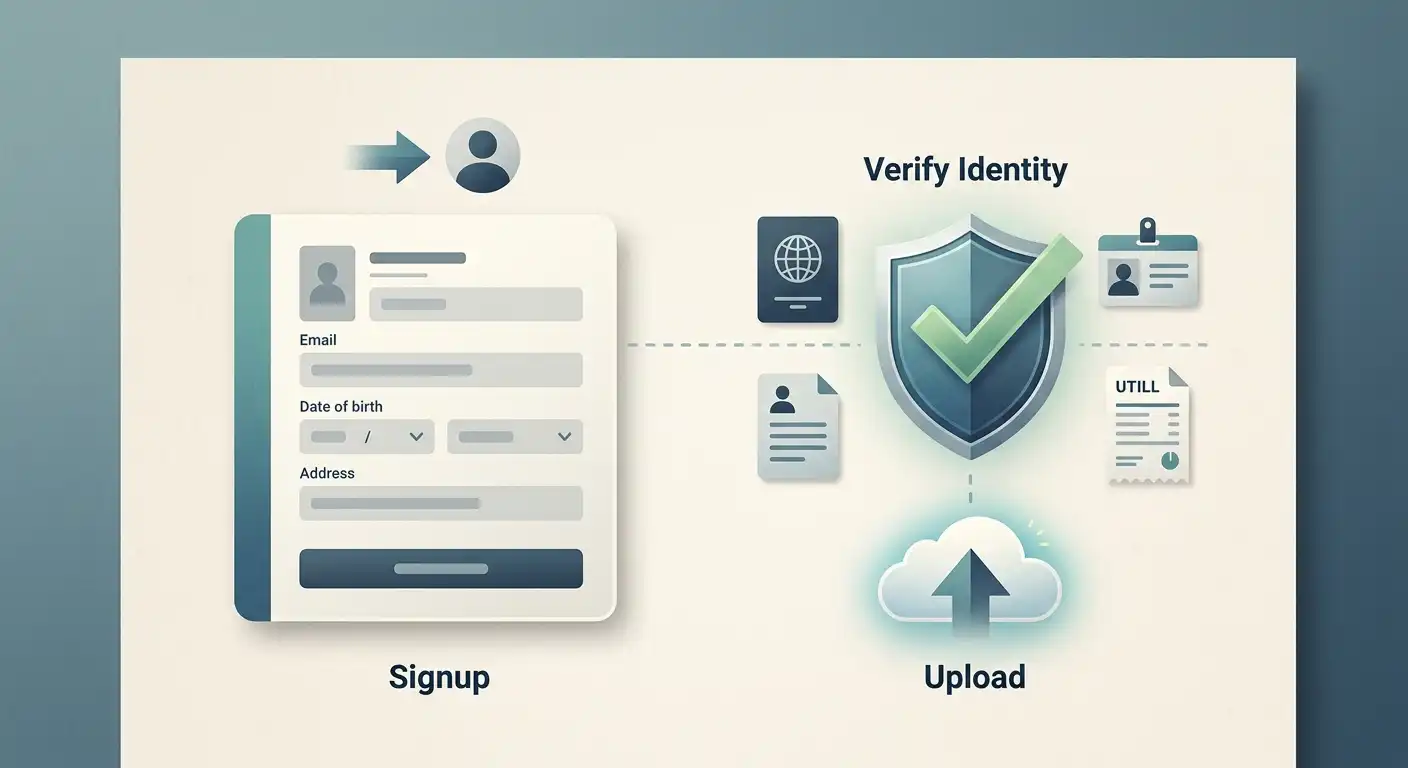
A “no KYC” label describes a claimed account or deposit experience; it does not establish that identity checks will be skipped when money is requested. The distinction matters because opening an account and releasing funds are separate decisions. A withdrawal can prompt a request for identity documents even where the earlier stages involved little or no verification.
A specialist review of casino verification practices reports that first withdrawals often trigger identity checks. That timing can make the label seem more absolute than the process: verification may be deferred until a balance is due to leave the account. A request for documents at that point is not, by itself, evidence that the initial label guaranteed an unrestricted cashout. The relevant question is what checks apply before the operator authorises payment.
Completing verification before making a withdrawal can significantly speed up later withdrawals. The practical difference is timing. If identity checks are completed early, a future request is less likely to be held up by the same outstanding step. If verification begins only after a withdrawal is submitted, the funds may remain pending while the requested information is reviewed. “No KYC” therefore should not be read as a reliable prediction of what happens at cashout.
The wording can also blur distinct ideas. A platform may permit account use without requesting documents immediately, while retaining the ability to verify identity before releasing funds. Those are not equivalent to never requiring verification. The latter interpretation treats the label as a permanent exemption; the former describes a process in which the check may occur later. For a withdrawal decision, the timing of the check is more consequential than the label attached to sign-up.
A useful way to assess the claim is to separate three stages: account access, the point at which verification is requested, and authorisation of a withdrawal. A “no KYC” description may refer only to the first stage. A first cashout can expose the second, and payment remains dependent on the third. Treating all three as one promise makes the expected outcome difficult to assess and can leave funds waiting for a step that was not apparent at registration.
For a no-KYC casino in Australia, the central issue is therefore not whether a page uses that phrase, but whether identity checks can still be required before withdrawal. The same distinction applies to crypto-focused descriptions, including searches for a no-KYC BTC or ETH casino: naming a currency does not change the verification question. No particular coin or account label, on its own, tells a player when documents may be requested.
The financial consequence is a delay in access to the balance, not a change in its stated amount. Early verification can reduce one avoidable point of friction in later withdrawals. Waiting until a cashout request to discover that verification is required puts the check directly in the withdrawal path. In accounting terms, the balance may be recorded, but it is not yet available cash.
That is the limit of what “no KYC” can safely communicate: it may describe a lighter initial process, but it should not be treated as proof that identity verification will never be requested. The first withdrawal is a point at which that distinction can become material. When identity checks are completed earlier, subsequent withdrawals can move more smoothly through the operator’s process.
A no-deposit label describes how a bonus is offered; it does not establish how much of the resulting balance can be withdrawn. The decisive term is the wagering base: the amount that must be played through before a cashout request is permitted. A bonus can appear as a balance without being immediately available as withdrawable funds.
A specialist review notes two possible bases: wagering may apply to bonus funds alone, or to the combined deposit and bonus. The first is preferable because the amount subject to the requirement is narrower. Where wagering applies to the combined balance, a deposit that accompanies a bonus also becomes part of the calculation. The cashout condition is therefore not determined by the bonus label alone.
The distinction can be represented without assuming a particular offer. Let B stand for bonus funds and D for a deposit. Under a bonus-only rule, the wagering base is B. Under a combined-balance rule, it is D + B. If the stated wagering condition is represented by W, the required play-through is calculated against one base or the other. The terms must specify which. Without that detail, the amount of play required—and thus when a withdrawal can be attempted—cannot be calculated reliably.
This matters especially when an offer is described as a no-deposit bonus. The absence of a required deposit does not by itself show that the bonus is free of wagering conditions, nor does it establish that the displayed balance can be withdrawn. The offer terms need to identify the wagering base and explain what must be completed before a cashout request is allowed. If the rule is unclear, the final withdrawable amount is unclear too.
A comparison of offers should therefore start with the calculation, not the headline. A bonus-only basis limits the calculation to the promotional funds; a combined basis includes the deposit as well. That is a material difference even if the advertised bonus amount is unchanged. The relevant figure is not merely the balance shown on screen, but the balance that remains eligible for withdrawal after the stated condition has been met.
The same distinction applies to offers promoted as crypto bonuses or as requiring no identity checks. Those descriptions do not change the wagering base. Payment method and verification claims do not determine whether wagering applies to B or to D + B. They also cannot make an unmet wagering condition disappear. An “instant withdrawal” label would not settle that calculation either.
For people physically in Australia, the legal position is separate from bonus arithmetic: the Interactive Gambling Act 2001 prohibits operators from providing real-money online casino games to customers in Australia. A bonus description does not alter that restriction. Where promotional wording is encountered, its financial terms should not be mistaken for evidence that the underlying service may lawfully be offered to Australians.
The practical reading is exact: identify the wagering base, determine whether it includes a deposit, and establish what must be completed before requesting withdrawal. If those terms do not define the base clearly, the offer does not provide enough information to calculate the amount that could become eligible for cashout.
PayID is Australia’s bank-to-bank instant payment system, operating through the New Payments Platform (NPP). That describes the transfer rail, not the time from submitting a withdrawal request to receiving money. The casino must first approve and release the payment. Only then can PayID’s real-time transfer capability apply. “Instant” therefore refers to the payment phase after approval, not the entire withdrawal process.
A specialist review reported PayID withdrawals at some leading Australian casinos taking less than five minutes, while standard bank transfers were reported at one to three business days. Those figures are a snapshot from that review, not a service guarantee or a measure of every operator. A separate specialist review described automatic approval for withdrawals below $5,000 AUD at top-tier services. Automatic approval is an operator-side setting, not a property of PayID, and it does not remove other checks or establish that a request will be released immediately.
The distinction matters for searches about a no-KYC casino withdrawal or an instant withdrawal without verification. A “no KYC” label does not ensure that a withdrawal can be paid without identity checks: casinos must verify identity before processing withdrawals. First-time checks, account details or an internal review can hold up approval while the payment network remains available. An instant payment method cannot make an unapproved request instant.
PayID transfers between bank accounts are processed in real time through the NPP and Osko. A report by filmink.com.au describes casino PayID withdrawals as almost instant after release, in contrast with bank transfers that may take several working days; the same report notes that a transaction fee may apply. The fee is not inherent in the PayID network. It is a condition to confirm in the operator’s terms alongside the withdrawal limits and processing times.
A withdrawal request may involve opening the account’s Wallet or Withdrawal area, entering the PayID identifier, specifying an amount and confirming the request. The details should match the account information used for the deposit, and funds should go only to an account linked to the casino profile. Using different PayID details can prompt a security review. A fast payment rail does not override account controls.
Limits also affect when the full balance arrives. Operator terms may set a minimum and maximum per withdrawal, as well as separate weekly or monthly cashout caps. Large withdrawals may be released in instalments under the operator’s policy, so a fast first transfer does not establish that the remaining balance will arrive in the same payment. Any applicable fee reduces the amount received; the relevant calculation is the approved withdrawal less that fee, not the advertised processing time.
PayID Withdrawal Process
Verification and Approval
The operator verifies the account and approves the withdrawal request.
Limits and Fees
The operator applies any applicable withdrawal limits or processing fees.
Bank Transfer
The funds are transferred in real time via the NPP and Osko network to the linked bank account.
There is a further legal boundary for Australian residents. The Interactive Gambling Act 2001 prohibits operators from providing real-money online casino games to people in Australia. PayID’s availability as a bank payment system does not make an offshore casino service lawful to provide locally, nor does a quick payout claim change that position. A practical assessment of a PayID withdrawal therefore separates three stages: verification and operator approval, any limits or fees, and the bank-to-bank transfer after release. Only the final stage is described as instant.
Payment timing has two parts: the platform’s approval of a withdrawal and the movement of funds through the payment network. A method described as fast may shorten the second part without removing the first. The distinction matters because a transfer estimate is not necessarily the time from submitting a request to receiving money.
E-wallets such as PayPal and Skrill sit toward the shorter end of the stated withdrawal ranges. A payment-method comparison describes e-wallet withdrawals as typically processed within 24 hours, while a specialist review reports that e-wallet transactions can be completed within hours rather than days. These are separate descriptions, not a single guaranteed deadline: processing varies, and an operator still has to release the funds.
Bank transfers have a longer potential window. A specialist review reports that a traditional transfer can take as many as five business days to complete. Another comparison places bank withdrawals among methods that may take several days. Business-day timing also means that weekends and bank-processing windows can affect when the money arrives. A transfer method may be familiar, but familiarity does not make settlement immediate.
That estimate should not be confused with card deposit timing: money entering an account and a payout returning to a card are different transactions. Debit cards are among the payment methods available at some real-money platforms; the timing of a particular withdrawal depends on the operator and payment arrangements.
Instant banking is a separate category from a conventional bank transfer. A specialist review reports that some real-money platforms in Australia have offered instant banking through providers such as POLi. That describes the availability of a payment route, not a promise that every withdrawal reaches a bank account instantly. The platform’s own approval stage remains separate from the payment service’s transfer stage.
Processed typically within 24 hours; some reports suggest transactions can be completed within hours.
A traditional transfer can take as many as five business days to complete.
Available through providers like POLi, though the platform's internal approval stage still applies.
Generally used for deposits and may not provide a route for receiving withdrawals.
Prepaid vouchers, including Neosurf, are generally described in a specialist review as deposit methods rather than cashout methods. Their practical limitation is therefore not a long withdrawal queue: they may not provide a route for receiving a withdrawal at all. If a deposit is made by voucher, the eventual payout may need to use another eligible method, subject to the platform’s rules.
| Method | Timing or withdrawal use |
|---|---|
| E-wallets | A specialist review describes transactions as taking hours rather than days; another comparison places withdrawals within 24 hours. |
| Bank transfers | A specialist review reports completion can take as many as five business days. |
| Cards | Withdrawals may take several days. |
| Instant banking | Offered by some platforms through services such as POLi; this does not settle the operator’s approval time. |
| Prepaid vouchers | Described as deposit options, generally not withdrawal methods. |
The useful comparison is not simply “fast” against “slow.” E-wallets and banking routes have stated withdrawal windows, while voucher use may end at the deposit stage. For any method, the published payout terms determine what happens after approval; a payment label alone does not establish the full time to receipt.
Ethereum, Tether and Ripple are often grouped together in searches about no-KYC casino payments, but naming an asset does not establish that a particular service accepts it. Nor does it establish which network is supported, what account conditions apply or whether a deposit can later be withdrawn through the same route. Those details depend on the service’s own terms.
A specialist review has described cryptocurrency transactions as capable of being near-instant. That is a broad statement about possible transaction speed, not a promise that every transfer involving Ethereum, Tether or Ripple will arrive immediately. Network activity and the steps required by a receiving service are separate parts of the process. A quick transfer on a network cannot, by itself, establish that an account has been credited or that funds can be withdrawn.
The phrase “no KYC” also needs careful interpretation. It is a label, not proof that identity checks will never occur. Australian law requires operators to verify player identity before processing withdrawals, and the label does not override that requirement. It cannot guarantee that a service will accept a given asset or release funds without checks.
There is a more fundamental limit in Australia: the Interactive Gambling Act 2001 makes it illegal for operators to provide real-money online casino games to people physically located in the country. Cryptocurrency does not change the legal status of the service. A payment method and a game offering are different questions; the presence of a digital asset does not make a prohibited service lawful.
For that reason, claims built around an Ethereum, Tether or Ripple deposit should be read narrowly. The asset name alone establishes neither availability nor withdrawal conditions, while general statements about crypto speed cannot be transferred to a specific coin or service. The useful distinction is between a possible network transfer speed and the separate legal, account and processing conditions surrounding any real-money casino transaction.
A payment label, a game category and a verification condition describe separate parts of an offer. Tether (USDT) refers to a cryptocurrency; “crash” describes a type of game; and “no KYC” refers to an operator’s stated approach to identity checks. Combining the terms does not establish that a particular service accepts that token, offers that game or waives checks when funds are withdrawn.
For deposits, a specialist review reported that prepaid cards and vouchers such as Neosurf could be used to add funds but not to withdraw them. That distinction matters to the cash balance: a deposit route may put money into an account without providing a route back out. A withdrawal may therefore need to use another method, subject to the operator’s terms. The deposit instrument alone does not settle how a later payout can be made.
A voucher-funded balance should not be treated as equivalent to a withdrawable balance. The relevant terms are the permitted deposit methods, the methods available for cashouts and any conditions attached to each. Promotional wording does not change those mechanics; a deposit option is not a payout promise.
The Australian legal position also limits how these terms should be understood. The Interactive Gambling Act 2001 makes it illegal for operators to provide real-money online casino games to people physically located in Australia. Online slots and other casino-style games fall within that prohibition. A search phrase combining a token, a game and a verification claim does not alter the legal status of the service or establish that it is available as a lawful local offering.
The practical distinction is narrow but material: voucher use concerns how funds enter an account, while withdrawal eligibility depends on a separate payout route and its conditions. Neither a deposit method nor a “no KYC” label, on its own, determines what can be cashed out.
A free-spin label does not change the legal status of the service offering it. Under Australia’s Interactive Gambling Act 2001, operators cannot provide real-money online casino games, including slots, to people physically located in Australia. A promotion attached to a prohibited service does not create an exception.
The distinction matters because “free” describes the advertised entry condition, not necessarily the full arrangement. It does not, by itself, establish whether winnings can be withdrawn, what restrictions apply, or whether a real-money casino service is lawful to provide in Australia. Those details cannot be inferred from the promotion’s name.
Sweden-specific information has a separate geographic scope. A term or offer associated with Sweden does not establish that the same service is available to people in Australia, or that it may lawfully be provided here. The Australian legal position turns on the service being offered to people physically located in Australia, not on the wording used in an overseas promotion.
Accordingly, free spins and Sweden-related casino terms do not provide a basis for treating an offshore real-money casino offer as an Australian option. Promotional wording is not a substitute for the legal classification of the underlying service.
A live-dealer format does not create an exception to Australia’s rules on real-money online casino games. The Interactive Gambling Act 2001 prohibits operators from providing casino games to people physically located in Australia, including table games such as blackjack and roulette. The format does not alter the legal status of the service.
That distinction matters when assessing claims about a live casino with no identity checks. The label alone establishes neither that a service is available to Australians nor what checks, payment conditions or withdrawal rules might apply.
The legal responsibility described by the Act falls on operators providing prohibited services; players are not liable for a fine or prosecution simply for playing at an offshore casino without a local licence. That does not make an offshore service lawful to provide in Australia, or establish that it can be accessed in practice. Offshore casino services are actively blocked and enforced against, and advertising real-money online casinos to Australian audiences is prohibited.
A live-casino label, therefore, is not evidence of a permitted local product or of a withdrawal process that bypasses identity checks. Availability and individual operator conditions cannot be inferred from the format name.
Payment methods mentioned include credit and debit cards, bank transfers, PayPal, Skrill and, at some operators, cryptocurrency. Prepaid vouchers such as Neosurf are generally for deposits, not withdrawals. Australian law prohibits operators from providing real-money online casino games to people physically in Australia.
E-wallet withdrawals are typically processed within 24 hours, while bank transfers and card payments can take several days; traditional bank transfers may take up to five business days. PayID casino payouts have been reported as taking under five minutes, but internal reviews, first-time verification and bank processing can cause delays.
Fastpay Casino, PlayAmo and National Casino were reported among the faster PayID payout options, with average times of 47 seconds, 68 seconds and 3.2 minutes respectively. These are reported payout speeds, not a recommendation: Australian law prohibits operators from providing real-money online casino games to people physically in Australia.
There is no lawful online casino for people physically in Australia to use for real-money games. When assessing payout claims, check whether withdrawal limits and fees are published, whether withdrawals are auto-approved, and whether identity checks or processing windows can delay payment.
Written by the editors at Norco Casino.