The guide explains the legal distinction for players and operators, then examines payment terms, bonuses, RTP variation and withdrawal conditions.

The legal distinction in Australia is between the company supplying online gambling and the person who plays. Under the Interactive Gambling Act 2001, a company must not provide real-money online pokies to people in Australia without a domestic licence. No such licences have been issued, so there is no Australian-licensed online casino. The prohibition is directed at operators, not individual players: a player is not committing an offence simply by using an offshore service that accepts Australian customers.
That distinction does not make an offshore casino an Australian-regulated service. A site may be based overseas, operate under a foreign licence or accept Australian customers, but none of those features gives it a domestic licence. Nor does the fact that an account can be opened or a game can be loaded establish that Australian consumer protections apply. The central legal position is straightforward: real-money online casino games, including pokies, cannot lawfully be offered to people physically in Australia by an operator without the required domestic authorisation, and no Australian online casino holds one.
Choosing online pokies in Australia means checking the details that matter to you before signing up. This list provides a concise reference to the available licensing, deposit and payout information for each operator.
Roby Casino
Roby Casino is listed with a Curacao eGaming licence held by Roby Games Ltd.
Playfina Casino
Playfina Casino has a Curacao eGaming licence held by Hollycorn N.V., which has held it since 2017. The minimum deposit is A$20–30, depending on the offer.
WinSpirit Casino
WinSpirit Casino is licensed by Antillephone N.V. under Curacao eGaming licence OGL/2024/923/0383. Its minimum deposit is A$30.
Lucky Dreams
Lucky Dreams is listed with a Curacao licence. Its minimum deposit is A$20 when using POLi.
Bizzo Casino
Bizzo Casino is listed with a Curacao Gaming Control Board licence held by TechSolutions Group N.V.
House of Pokies
House of Pokies lists an international iGaming licence, though the source does not name the jurisdiction. PayID payouts are stated as taking 1–24 hours, and the minimum deposit is A$30, or A$10 when using PayID.
7Bit Casino
7Bit Casino is listed as operating under a Curacao licence, with Dama N.V. as its operator.
Golden Pokies
Golden Pokies is listed with a Curacao licence; no further operator details are provided here.
SkyCrown
SkyCrown is licensed by the Tobique Gaming Commission. Its stated payout times are around 10–15 minutes for crypto and 1–5 days for fiat, with a minimum deposit of A$30.
Ricky Casino
Ricky Casino lists crypto payouts in under an hour and PayID payouts in 1–3 business days. The minimum deposit is A$20, or A$30 to qualify for the bonus.
The Australian Communications and Media Authority (ACMA) is the principal domestic regulator enforcing the Act. It can take action against prohibited services, including arranging for internet service providers to block access to offshore gambling sites on its blocklist. A blocked page is therefore not evidence of a defect in a player’s device or account; it may reflect an enforcement measure. At the same time, blocking does not erase the underlying commercial risk of dealing with an offshore operator. A service may remain visible or reachable through other routes, but that does not convert it into an Australian-licensed business.
For players, the difference is practical rather than merely technical. Australian law does not impose player liability for using an offshore site that accepts them. However, if that operator refuses to pay winnings, an Australian player has no legal recourse in Australia against it. A foreign licence, if one is claimed, is not an Australian licence and does not create an Australian complaints route. The player may face the difficulty of pursuing a business located outside the country, while Australian authorities do not provide the equivalent domestic protections that would apply to a locally licensed casino. The important distinction is not whether the site describes itself as legitimate, but whether an Australian remedy exists when a dispute arises. For an offshore casino, it does not.
This also explains why account access and legal protection should not be treated as the same thing. A working login, a completed registration or an accepted deposit would show only that the site processed those actions. None establishes that the operator is authorised to provide real-money pokies in Australia, and none guarantees that a later withdrawal dispute can be resolved through Australian law. The absence of a domestic licence is not a minor disclosure buried in terms; it is the defining feature of this market.
BetStop has a narrower role than its name may suggest in this context. It applies to Australian-licensed operators and does not bind offshore sites. Since there are no Australian-licensed online casinos, registration with BetStop should not be assumed to prevent access to an offshore pokies account or marketing from an offshore operator. It is a self-exclusion service within its applicable scope, not a general technical block on every gambling site available online. That limit matters: a safeguard designed for participating Australian-licensed services cannot supply the controls of a domestic casino market where no such online casinos exist.
The legal age for gambling in Australia, including online pokies, is 18. Meeting that age requirement does not change the operator’s position under the Interactive Gambling Act, nor does it create a right to Australian assistance if an offshore site withholds funds. Age eligibility, operator authorisation and enforceable remedies are separate questions. Conflating them turns a basic eligibility rule into a misleading impression of protection.
In financial terms, offshore access carries a simple asymmetry: the law targets the supplier, while the player is not prosecuted merely for playing; yet a player who loses access to winnings has no Australian legal recourse against the offshore casino. That is the position to keep in view when encountering claims about real-money pokies in Australia. The ability to use a service is not proof that it is locally authorised, and the operator’s availability does not make Australian remedies available.
The phrase “online pokies in Australia” describes a search for a familiar form of gambling in an unfamiliar setting. A physical pokie is encountered at a venue; an online version is reached through a website or app. That difference matters because access can depend on more than whether a page loads. The site may be unavailable, blocked, or subject to controls that do not operate in the same way as protections attached to Australian-licensed services.
The Australian Communications and Media Authority (ACMA) blocks access to illegal offshore gambling sites. Internet service providers are required to apply ACMA’s blocklist, so a site that was accessible at one point may later fail to load through a particular connection. A block is an access restriction, not a quality rating. It does not tell a user whether a site is fair, whether it will pay winnings, or whether its games use a particular return setting.
That distinction is easy to miss when a page, app, or payment route appears to work. Technical access is not the same as oversight or consumer protection. Nor does an online service become safer simply because it resembles a familiar Australian website or accepts a locally used payment method. Those details describe how a service operates, not what recourse is available if a dispute arises.
Access can also be inconsistent. A blocked page may produce an error, fail to appear in results, or behave differently across networks. That can lead to repeated attempts to reach the same destination, but a changing technical result does not change the underlying restriction. ACMA’s blocklist is specifically aimed at illegal offshore gambling sites, and providers are required to follow it. The practical consequence is that availability cannot be treated as a dependable feature.
Search results and site presentation can make this landscape look more settled than it is. Promotional language may present “online pokies” as a straightforward digital version of venue play. In practice, the relevant questions are less about the label and more about access, account controls, and what happens when a user tries to stop. A polished interface is not a substitute for safeguards that can actually apply to the service.
Responsible-gambling tools are one part of that assessment. Deposit limits set a ceiling on money put into an account. Loss limits are designed to constrain losses, while session time limits can restrict how long play continues. Self-exclusion is a separate measure: it is intended to prevent further access rather than merely place a boundary around spending or time. These controls address different points in the activity, so one should not be mistaken for another.
The presence of a control on a screen does not, by itself, establish how effectively it works. Its scope, activation process, and ability to prevent further play matter. A limit that can be changed immediately has a different practical effect from one that holds firm; an exclusion that applies only to one account does not necessarily reach other services. The wording and operation of each tool therefore matter more than a generic “responsible gambling” label.
BetStop requires particular care in this context. It applies to Australian-licensed operators and does not bind offshore sites. Since the distinction is about which operators fall within its reach, registering with BetStop should not be treated as a universal block on online gambling access. It cannot be assumed to exclude a person from an offshore service that sits outside its scope. That limitation is material: a self-exclusion measure is only useful for the services it covers.
A realistic view of online pokies in Australia therefore separates three issues that are often bundled together: whether a site can be reached, whether it provides meaningful controls, and whether those controls extend beyond that one service. ACMA blocking addresses access to identified illegal offshore gambling sites. Deposit, loss, and session limits concern the boundaries set within an account. Self-exclusion concerns continued access, but BetStop’s reach is limited to Australian-licensed operators and does not extend to offshore sites.
None of these mechanisms should be read as proof that an online service is safe or properly supervised. A page loading successfully does not establish that it is outside ACMA’s blocking action, and a menu of account controls does not establish that an exclusion will cover every site. The practical setting is therefore less like a single national online venue and more like a fragmented environment in which access and protections have different scopes. That is the point to keep in view when interpreting claims about Australian online pokies: availability is a technical fact, while protection depends on the reach and operation of the relevant control.
A no-deposit offer, a sign-up bonus and a deposit match describe how promotional credit is presented; none states how much must be wagered before a withdrawal is permitted. The operative term is the wagering requirement, also called the turnover multiplier. It is applied to a specified base amount, and that base determines the total betting task.
The terms should identify whether turnover is calculated on the bonus alone or on the deposit and bonus together. Those are materially different calculations, even when the multiplier appears lower in the second offer. A headline figure without its calculation base is incomplete: the advertised credit is not the amount of betting required, and it is not automatically cash available to withdraw.
For a bonus-only requirement, the multiplier applies to the bonus amount. A specialist review uses a $500 bonus with a 40x requirement to illustrate the calculation: $500 multiplied by 40 produces $20,000 in required bets before the bonus winnings can be withdrawn. The point is the turnover, not the bonus’s face value. A balance can appear substantial while remaining subject to a much larger wagering condition.
A deposit-plus-bonus requirement uses both amounts as its base. In the comparison supplied by a specialist review, a $500 deposit paired with a $500 bonus at 35x creates a $1,000 base. Multiplying that by 35 gives $35,000 in required bets. The lower multiplier does not make this a lighter condition than the bonus-only example; the larger base changes the final figure. Comparing multipliers in isolation therefore gives a misleading result.
The relevant wording is explicit: “bonus only” means the bonus amount is multiplied; “deposit plus bonus” means both are included. If the offer does not clearly state the base, its headline cannot be converted into a reliable turnover total. Any other qualifying conditions should also be read alongside the calculation, because meeting the turnover figure alone does not establish that a withdrawal will be approved.
Calculating Turnover
Identify the base
Determine if the wagering requirement applies to the bonus only or the combined deposit and bonus.
Apply the multiplier
Multiply the identified base amount by the turnover multiplier (e.g., $500 bonus × 40x = $20,000).
Check for caps
Verify if a separate cash-out cap limits the final amount that can be withdrawn regardless of turnover.
The same arithmetic applies to a sign-up bonus or an offer described as no deposit. “No deposit” refers to the entry condition, not to the effort required to release any resulting winnings. A promotion can require no initial payment and still attach a wagering obligation to its credited amount. For a deposit match, the amount deposited may also enter the calculation if the terms define the base that way.
A specialist review’s benchmark is to regard requirements of 35x or less as a more restrained range, while treating anything above 40x as punishing. This is an evaluative threshold, not a guarantee of value or a universal industry rule. A lower multiplier can still produce substantial turnover when it applies to a larger base; a higher one increases the task further. The final amount of required betting is the useful comparison, not the promotional label.
Free-spin promotions require a separate check. A specialist review notes that winnings from free spins may be subject to a cash-out cap. That condition limits the amount that can be withdrawn from the offer, independently of how attractive the spins or their potential returns appear. The cap and any wagering requirement answer different questions: one concerns the turnover needed to qualify, the other the amount that may ultimately be cashed out.
The practical comparison is therefore a short calculation: identify the amount subject to wagering, multiply it by the stated requirement, then check whether a separate cash-out cap applies. A bonus with a large headline can carry a larger turnover obligation; a free-spin win can face a withdrawal ceiling. Promotional wording describes the entry point. The terms determine the amount that can leave the account.
PayID is a payment alias, not a separate bank account or a measure of how an online service is regulated. It sits over Australia’s New Payments Platform (NPP), allowing a transfer to be addressed using an email address, mobile number or ABN rather than conventional account details. The NPP is supported by all major banks and uses end-to-end encryption. Those features describe the payment infrastructure; they do not establish what a merchant is permitted to offer.
For a real-money deposit at an online casino, PayID must first be linked to a bank account. The alias provides a way to direct a transfer, while the linked account is where the funds come from. Without that bank-account connection, PayID is not a standalone balance that can be used to fund play. This is the practical distinction behind searches for PayID pokies in Australia: the payment method depends on a bank relationship, not merely on seeing a PayID logo or option on a payment screen.
That distinction also matters when a payment route is presented as especially simple. A merchant may display PayID as an available method, but a displayed option does not establish that a transfer will be accepted by the bank. The bank’s own handling of a transaction remains relevant. A transfer can therefore be listed as supported by a site and still fail at the point where the bank processes it.
A specialist review has reported that some Australian banks, including members of the Big Four, occasionally block PayID transfers to known gambling merchants. That is a report about possible bank behaviour, not a guarantee that every bank blocks such payments or that a particular transfer will be stopped. Policies and transaction handling can change. A payment option’s presence on a site cannot settle the question in advance.
PayID’s role should also be kept narrow. It is a way to address a bank transfer through an alias; it is not a certificate of licensing, fairness or return-to-player transparency. Encryption concerns the protection of information in transit. It does not verify the terms of a gambling service, the handling of a withdrawal, or the RTP setting of a pokie. Treating payment technology as a quality mark would confuse the route taken by money with the conditions attached to the service receiving it.
The same point applies to searches for “best PayID pokies” or other variations of that phrase. A payment method is a transaction detail, not a meaningful ranking criterion by itself. PayID does not show whether a game uses a particular RTP setting, whether a payout will be approved, or what conditions apply to an account. Those questions need separate evidence and cannot be answered by the payment logo.
There is also a difference between an alias being technically available and a payment being practically usable. The first describes the method offered on a payment page. The second depends on the account link and on whether the bank processes the transfer. A failed payment does not, by itself, prove a fault with the NPP or with the PayID alias; nor does a successful transfer prove anything about the merchant beyond the fact that the transaction went through.
For anyone assessing a PayID deposit route, the useful facts are limited but concrete: an email address, mobile number or ABN can serve as the alias; a bank account must be linked for real-money use; and a bank may decline a transfer to a known gambling merchant. Everything else—licensing, game fairness, RTP disclosure and withdrawal treatment—belongs to a different assessment. PayID makes the transfer address easier to specify. It does not make the recipient more trustworthy.
A free-spin offer has a cash value only to the extent that its terms allow winnings to be withdrawn. A specialist review reports that some free-spin promotions may cap the amount that can be cashed out. The spin itself can produce a balance on screen, but that balance is not necessarily the amount ultimately available as cash.
The cap changes the calculation. If winnings exceed the stated maximum, the excess does not increase the permitted cash-out. The relevant figure is therefore not the largest result displayed during play, but the amount the offer’s terms allow to leave the account. Without that distinction, “free” describes the entry mechanic, not the final value.
For Australia-based searches for free spins on online pokies, the offer should be assessed as a separate set of conditions rather than as cash with no strings attached. The cap is the central financial term here: it sets a ceiling on the promotional winnings that can be withdrawn. A large on-screen balance can therefore have a smaller permitted cash value. The gap is not a technicality; it is the difference between a game result and a payable amount.
The amount of any cap needs to be stated in the offer terms. If the terms do not make the limit clear, the value cannot be calculated reliably from the promotional headline. Nor does the word “free” resolve the uncertainty. It says nothing by itself about the portion of winnings that may be cashed out.
A useful comparison is based on the maximum cashable amount, not the number of spins or the excitement attached to the offer. Two promotions may both advertise free spins, yet a different cash-out ceiling would give their winnings different practical value. Where no cap applies, that should also be clear in the terms; where one does apply, the ceiling belongs in the calculation from the start.
This distinction matters even when no deposit is attached to the spins. A promotional balance and withdrawable cash are not interchangeable categories. The first describes what appears within the offer; the second is constrained by the conditions attached to it. Treating them as the same amount overstates the financial value.
Free Australia pokies promotions are therefore best read as capped or uncapped claims, not as guaranteed cash. The cap does not predict what a spin will win. It limits what can be cashed out if winnings are produced. That makes the offer’s maximum payable amount a more useful measure than its headline description—and a less flattering one, when the two differ.
Skrill and Neteller are examples of e-wallets discussed in connection with online pokies in Australia. A specialist review describes wallets of this kind as valued for speed and relative anonymity. That is a reported appeal, not a guarantee about how a particular payment will work or what information an operator may request.
An e-wallet sits between a bank or card account and a merchant: funds are held or managed through the wallet service, then used for a transaction where the operator offers that method. This can separate the payment interface from the bank account used to fund the wallet. It does not make the transaction untraceable, remove the wallet provider from the payment chain, or establish anything about an operator’s licensing, fairness or game returns. “Relative anonymity” is narrower than anonymity without qualification.
The practical trade-off is an additional account and set of terms to manage. Wallet availability depends on the payment options presented by the operator and the wallet provider; neither should be assumed to support every transaction. Fees, account conditions and processing arrangements need to be checked in the relevant terms before funds are moved. A wallet label alone does not settle the final cost or timing.
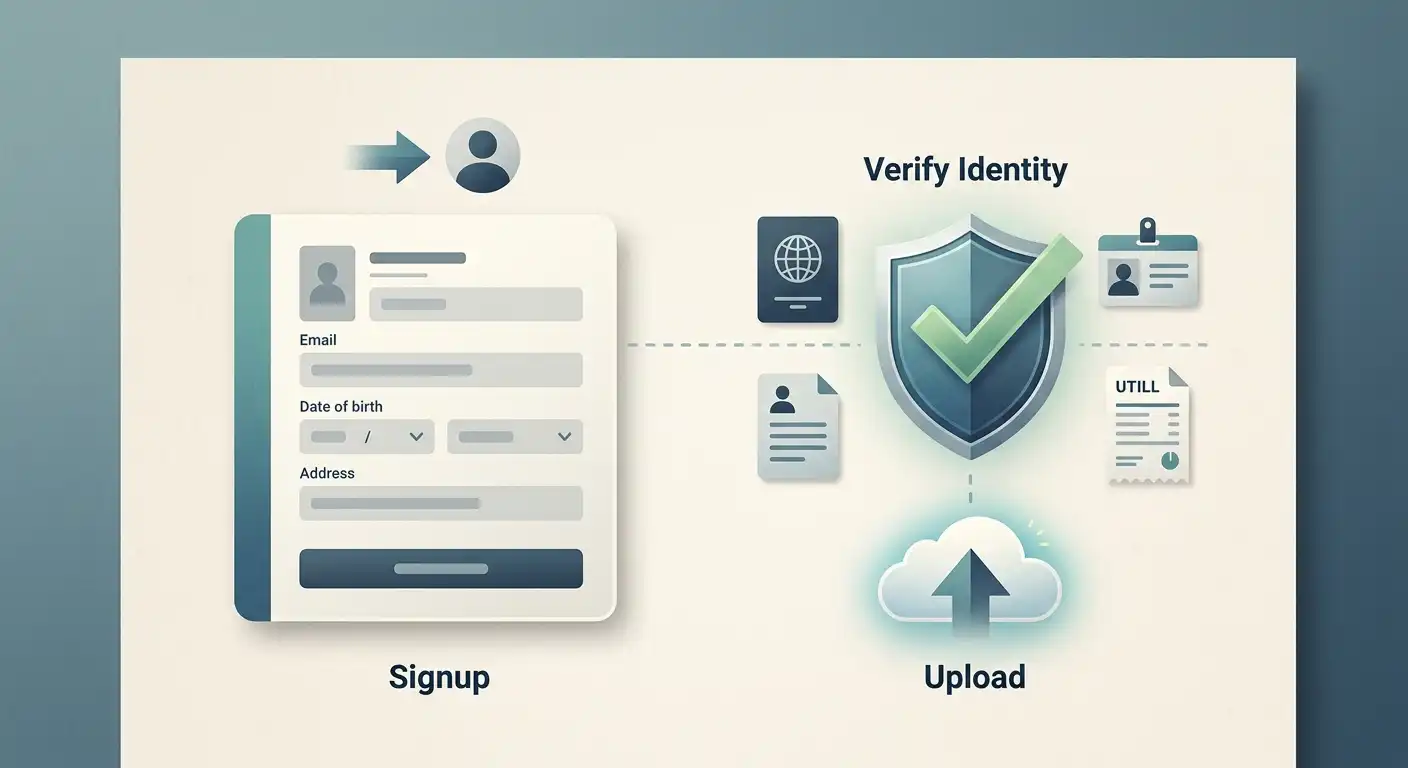
The payment route also does not remove identity checks. Before a first withdrawal, identity and address documents must be verified. An e-wallet deposit therefore does not mean that a later cash-out can be made without providing personal documentation. The account name and payment details should be consistent with the operator’s requirements, since a mismatch can complicate a transaction.
Nor is a wallet a substitute for an Australian gambling safeguard. BetStop applies to Australian-licensed operators; it does not bind offshore sites. Since there is no Australian-licensed online casino, the presence of Skrill or Neteller as a payment option should not be read as a local consumer protection or endorsement.
Despite the relative anonymity of e-wallets, operators still require identity and address documents to be verified before a first withdrawal can be processed.
The useful comparison is consequently limited: an e-wallet may offer a different way to move funds and may be valued for speed and reduced direct exposure of bank details to a merchant. Those conveniences sit alongside dependence on a separate provider, its rules and its handling of account information. They do not resolve the more consequential questions about withdrawal conditions or the status of the service receiving the funds. A payment method can be convenient at the deposit stage and still leave the withdrawal subject to verification and operator terms.
A pokie’s title does not establish its return to player (RTP). Some game providers allow casinos to choose between multiple RTP configurations for the same game. A specialist review has reported this practice, so a published percentage needs to be checked against the specific casino and game version rather than assumed from the title alone.
RTP is a theoretical long-run measure of the share of stakes a game returns across play. It is not a forecast for an individual session, nor a promise that a particular player will recover a stated portion of their bets. Even when a game’s name and appearance match, a different configured RTP can mean a different theoretical return.
The practical comparison is therefore between the exact version available at each casino, not between game names in a catalogue. Where a casino publishes an RTP, the figure should be tied clearly to that version. If the information is absent or ambiguous, the return cannot be established from the game title alone. A familiar name is not a percentage.
This distinction matters when assessing claims about the top online pokies in Australia. A ranking based only on popularity or recognition may omit a material setting that affects the game’s theoretical return. The same title appearing in two lists does not prove that both versions use the same RTP.
RTP also does not measure whether a game is enjoyable, how often it pays, or the size and timing of individual wins. It summarises expected returns over a very large volume of play; short-term results can differ substantially. Comparisons are meaningful only when the stated figures refer to the actual configurations being compared and are presented on the same basis.
For top Australia online pokies, the game name is a starting point, not enough evidence for a return comparison. The relevant detail is the RTP setting attached to the version offered, with any uncertainty left visible rather than filled by assumption.
A card can be declined before any deposit reaches an account. A specialist gambling-payment review reports that Australian banks and card issuers are increasingly blocking transactions identified as payments to gambling sites. That is a changing payment policy, not a dependable rule for every card or transaction. A decline may reflect the issuer’s restrictions rather than a fault with the card details.
Approval does not settle the cost. A bank or card issuer may classify a gambling deposit made by credit or debit card as a cash advance. A specialist review of gambling payments reports possible fees of 3–5% and interest starting immediately. On a AU$100 deposit, a 3–5% fee would add AU$3–AU$5, before interest. The posted deposit is therefore not necessarily the full amount charged to the card account.
The classification matters more than the label shown at checkout. If the issuer processes the payment as a cash advance, the transaction may carry different charges from an ordinary purchase. Whether that happens depends on the issuer and how the transaction is coded; a casino’s displayed deposit amount cannot confirm the card’s final treatment. The card statement and the issuer’s terms determine the actual cost.
Credit-card use also has a separate legal constraint in Australia: online gambling services must not accept credit-card payments. A payment page presenting a card field does not establish that credit-card gambling deposits are permitted. Debit-card treatment should not be assumed to match credit-card treatment, either; the issuer may apply its own classification and restrictions.
For a cost check, the relevant figures are the deposit amount, any cash-advance fee, and when interest begins. Those charges can make a small card payment more expensive than its face value, while a blocked transaction provides no completed deposit at all. Card availability is therefore neither a guarantee of acceptance nor evidence about the gambling site’s reliability.
A new site’s deposit page shows how money enters; its withdrawal rules determine how much can leave and when. For unfamiliar Australia online pokies services, those terms deserve examination before any funds are committed. A displayed jackpot is not the same as a balance available for immediate payment.
A specialist review has reported weekly or monthly withdrawal ceilings in the $5,000–$10,000 range at some casinos. Under a $10,000 monthly ceiling, a $50,000 win would require five months of payments, assuming the ceiling applies in full each month and no other condition delays release. A lower cap extends the schedule. The useful comparison is therefore not just the advertised maximum win, but the payout ceiling and how it applies over time.
The wording matters. A limit may apply per week or month, per account, or to a particular payment method. The terms should also state what happens to amounts above the limit and whether a pending withdrawal counts toward the next period. If the rule is unclear, the timing of access to a balance is unclear too.
Identity checks can be another condition before the first withdrawal. A specialist review reports that casinos may request a photograph of an identity document and proof of address; some may also ask for a selfie holding the document. These checks can make a withdrawal dependent on documents being supplied and accepted, rather than on the account balance alone.
Before depositing, compare the verification requirements with the available documents and check that the account details match them. Read the payout rules for caps, processing conditions and any stated document requirements. That is a practical assessment of withdrawal access, not evidence that the site is authorised to provide real-money pokies in Australia.
Practice play can show how a pokie’s controls work: where a bet is set, how a feature is triggered, or how the screen presents a result. It cannot establish what a later spin will produce. Each spin is generated separately by a Random Number Generator (RNG), so a previous result does not make a particular outcome more or less likely on the next one.
That distinction limits what a run of practice can demonstrate. A sequence of wins may feel like a pattern, but it does not predict another sequence. A long stretch without a feature does not mean one is due. The RNG determines each result afresh; the visible history is not a forecast.
Practice results also say little about the money consequences of real play. A simulated balance does not show how a cash balance would change under the same sequence, and a short run cannot establish a reliable expectation of return. It can familiarise someone with the interface, but it cannot remove the uncertainty built into each spin.
Accordingly, practice is useful as a test of mechanics, not as evidence that a pokie is likely to pay. Treating a handful of outcomes as a strategy turns randomness into a story. The next result remains uncertain, regardless of what happened before it.
Written by the editors at Norco Casino.