The guide separates operator licensing from player liability and explains how deposits, bonuses, withdrawals and mobile access affect real-money play.

The central distinction in Australia is between the conduct of an operator and that of an individual player. The Interactive Gambling Act 2001 makes it unlawful for a company to provide real-money online pokies to people in Australia without a domestic licence. No domestic licences for online casinos have been issued, so there is no Australian-licensed online casino offering these games.
The restriction concerns the service being supplied, not a player committing an offence merely by playing. Australians are not made criminally liable under this rule for using an offshore site that accepts them. That does not make the site locally licensed or give its customers the protections that would come with an Australian-regulated online casino. The legal position of the operator and the practical position of the player are different questions; treating them as the same is a costly shortcut.
A site may be reachable from Australia, accept registrations or display real-money games, but none of those features changes the domestic licensing position. If the operator is providing real-money pokies to people in Australia, it is operating in conflict with the Interactive Gambling Act. A foreign licence, where a site claims to have one, does not amount to an Australian licence.
Choosing a real-money pokies site in Australia calls for more than a catchy offer: check the available licensing and payment details before deciding where to play. This list highlights the specific facts available for each operator.
Roby Casino
Roby Casino is listed as operating under a Curaçao eGaming licence held by Roby Games Ltd.
Playfina Casino
Playfina Casino is licensed by Curaçao eGaming through Hollycorn N.V., which has held the licence since 2017. The minimum deposit is A$20–30, depending on the offer.
WinSpirit Casino
WinSpirit Casino holds a Curaçao eGaming licence, OGL/2024/923/0383, issued to Antillephone N.V. Its minimum deposit is A$30.
Lucky Dreams
Lucky Dreams is listed as Curaçao-licensed and accepts a minimum deposit of A$20 via POLi.
Bizzo Casino
Bizzo Casino is licensed by the Curaçao Gaming Control Board, with TechSolutions Group N.V. named as the operator.
House of Pokies
House of Pokies lists an international iGaming licence, though the source does not name the jurisdiction. PayID payouts are stated as taking 1–24 hours, and the minimum deposit is A$30, or A$10 when using PayID.
7Bit Casino
7Bit Casino is listed as Curaçao-licensed and operated by Dama N.V.
Golden Pokies
Golden Pokies is listed as operating under a Curaçao licence.
SkyCrown
SkyCrown is licensed by the Tobique Gaming Commission. Its stated payout times are around 10–15 minutes for crypto and 1–5 days for fiat; the minimum deposit is A$30.
Ricky Casino
Ricky Casino lists crypto payouts in under an hour and PayID payouts in 1–3 business days. The minimum deposit is A$20, or A$30 to qualify for the bonus.
The law’s reach is also reflected in access restrictions. The Australian Communications and Media Authority (ACMA) is the principal domestic regulator responsible for enforcing the Act. It can arrange for illegal offshore gambling sites to be blocked, and Australian internet service providers must follow the resulting blocklist. A site that opens today may therefore not remain accessible in the same way. Access is not evidence of approval; a block is a regulatory measure, not a verdict on an individual player.
This distinction matters when assessing pages that describe real-money pokies in Australia as though they were ordinary locally regulated services. The absence of a domestic licence is not a minor disclosure beside a list of features. It changes the available route for resolving disputes. Australian players have no legal recourse in Australia if an offshore casino refuses to pay winnings. A promise made on a site, or the apparent availability of a game, does not create a local regulator with power to enforce that promise on the player’s behalf.
The lack of Australian legal recourse is the practical risk at the centre of the market. If an offshore operator withholds a balance or disputes a payout, the player cannot rely on an Australian online-casino licensing system to intervene. This does not establish that every offshore operator will refuse payment. It means the domestic remedy that would follow from a local online casino licence is absent.
The same boundary applies to trust signals. A familiar interface, an account page, or the ability to access pokies online does not change the legal status of the service. Nor does the fact that an operator accepts Australian customers create a domestic licence. The relevant question is not simply whether a site works from Australia, but what legal protections are available if the relationship breaks down. For offshore real-money play, the answer is limited: Australian players have no legal recourse in Australia against a casino that refuses to pay.
ACMA’s blocking role should not be confused with individual dispute resolution. The regulator enforces the law governing the supply of prohibited services and can restrict access to sites on its blocklist. That function is different from adjudicating a player’s claim for winnings from an offshore casino. A blocked site may become harder to reach, but blocking does not itself recover money or guarantee that an operator will honour an account.
The legal age for gambling in Australia, including online pokies, is 18. That age requirement does not provide a licensing route for offshore casinos: being old enough to gamble does not make an unlicensed online casino locally authorised. Age and operator status are separate conditions.
For anyone comparing real-money pokies in Australia, the legal framework therefore has two parts. The operator is prohibited from supplying the service to people in Australia without a domestic licence, and no such online casino licences have been issued. The individual player is not targeted by that prohibition simply for playing, but has no Australian legal recourse if an offshore casino refuses to pay. ACMA enforces the law and can restrict access, while a site’s continued availability does not establish that it is approved.
This is the context for every practical feature attached to offshore play. Payment options, promotions and device access may describe how a service operates, but none removes the underlying legal gap. The useful distinction is between something being accessible and something being locally licensed, enforceable and supported by Australian recourse. In this market, those are not interchangeable descriptions.
PayID is a way to address a bank transfer, not a separate bank account or a guarantee that a payment will be accepted. It uses an alias—an email address, mobile number or Australian Business Number (ABN)—in place of the recipient’s bank details. The transfer itself moves through Australia’s New Payments Platform (NPP), which major banks support and which encrypts transfers end to end.
For real-money play at an online casino, PayID must first be linked to a bank account. The alias identifies the account for a transfer; it does not remove the bank from the transaction. That distinction matters when assessing a failed deposit: the payment method may be available in principle, while the bank or the receiving service may still prevent a particular transfer.
The NPP is the underlying payment infrastructure, while PayID supplies the address used to direct a payment. Having an alias therefore does not mean that a casino account is funded automatically. The account holder initiates a transfer through their bank, and the payment depends on the details and instructions presented at the point of deposit. If a site lists PayID, its own deposit instructions still need to be read carefully; the label alone does not establish how a particular transaction will be handled.
PayID’s connection to a bank account can make it look familiar beside other everyday bank transfers. That familiarity should not be treated as evidence about the recipient. It says something about the payment route, not about the quality or status of an online pokies service. PayID support does not prove that a site is licensed, that its games are fair, or that its return-to-player information is transparent.
A specialist review describes PayID as being handled like other qualifying deposit methods at the site it covers. That is a statement about that site’s payment treatment, not a general rule for every operator. The practical point is narrower: where a service accepts PayID, its deposit and account conditions determine how the method is applied. A payment button or a familiar bank-transfer process cannot substitute for checking those conditions.
Nor does a completed transfer settle every question about an account. It records that money moved through a payment channel. It does not, by itself, establish what the recipient will do with a later request, or what protections apply if a dispute arises. Treating a successful deposit as proof of reliability would confuse the mechanics of payment with the separate question of what happens after the funds arrive.
PayID availability does not mean every attempted payment will go through. A specialist review reports that some Australian banks, including banks among the Big Four, sometimes block PayID transfers to gambling merchants they identify. Bank controls can therefore affect access to the payment route even where a site displays PayID as an option.
A declined transfer is not necessarily evidence that the alias was entered incorrectly, and a listed payment method is not a promise that a bank will permit the payment. The reason can depend on the bank’s handling of a transaction to a known gambling merchant. The available information may not make the cause obvious from the deposit screen alone.
The difference is material: PayID describes how a transfer can be addressed and sent, while bank controls can determine whether it proceeds. The NPP’s broad bank support does not mean that every bank approves every kind of payment. A payment rail can be widely supported and still be subject to restrictions at the point where a customer tries to use it.
For a deposit decision, the relevant facts are the bank account linked to PayID, the recipient details supplied by the service and the bank’s response to that transaction. If a transfer is declined, repeatedly attempting variations of the same payment does not turn the method into an assurance of acceptance. The failure is a practical limit of the route, not a verdict on the game or the site’s claims.
The same distinction applies to wording such as “PayID pokies” or “online pokies with PayID.” Those phrases describe a payment option attached to an online service; they do not establish that the service is trustworthy or that the transfer will be available from every bank. In the phrase “PayID pokies real money,” the payment term still refers only to the deposit mechanism. The money moves through a bank-linked payment arrangement, and that mechanism should be assessed on that basis alone.
PayID is therefore best understood as a transfer address layered over the NPP, with a bank account required for use and bank controls capable of interrupting a payment. Its familiar format may simplify the routing details, but it does not change what the payment proves. A transfer method is one line in the transaction—not a trust certificate.
The practical difference between free play and real-money play is not the appearance of the pokie. It is whether money enters the account under conditions that can affect a balance, a withdrawal or access to play. A free-play mode may let someone try a game without staking deposited funds, but its credits are not automatically cash and do not establish that a real-money session will produce a return.
The label alone is not enough to identify the arrangement. A free-play option may be a demonstration with no cash value; a real-money account involves a deposit and the operator’s account conditions. A screen showing the same symbols and controls can therefore represent two different financial situations. The relevant distinction is what the balance represents and whether the terms allow it to be withdrawn.
Once a deposit is involved, the amount credited is subject to the operator’s rules. Those rules may cover account eligibility, accepted payment methods, minimum deposits and the steps required before money can be taken out. A deposit is not simply a larger quantity of free-play credits: it brings a financial transaction and account conditions into the picture.
A specialist review reports minimum deposits ranging from AU$5 to AU$20 across the operators it assessed. That range is not a universal threshold or a promise that a particular site will accept a given amount. The applicable figure must be checked against the operator’s current terms before any transfer. A stated minimum also says nothing by itself about how much play is affordable or whether a deposit can later be withdrawn without restrictions.
A specialist review found minimum deposits ranging from AU$5 to AU$20 across assessed operators. These figures are not universal and must be verified against current operator terms.
Free-play access avoids that particular deposit decision, but does not make the two account types equivalent. If the free-play balance cannot be cashed out, it has no direct monetary value to the player. If an offer attaches conditions to credits or winnings, those terms determine what the balance means. The label “free” does not settle the issue; the account rules do.
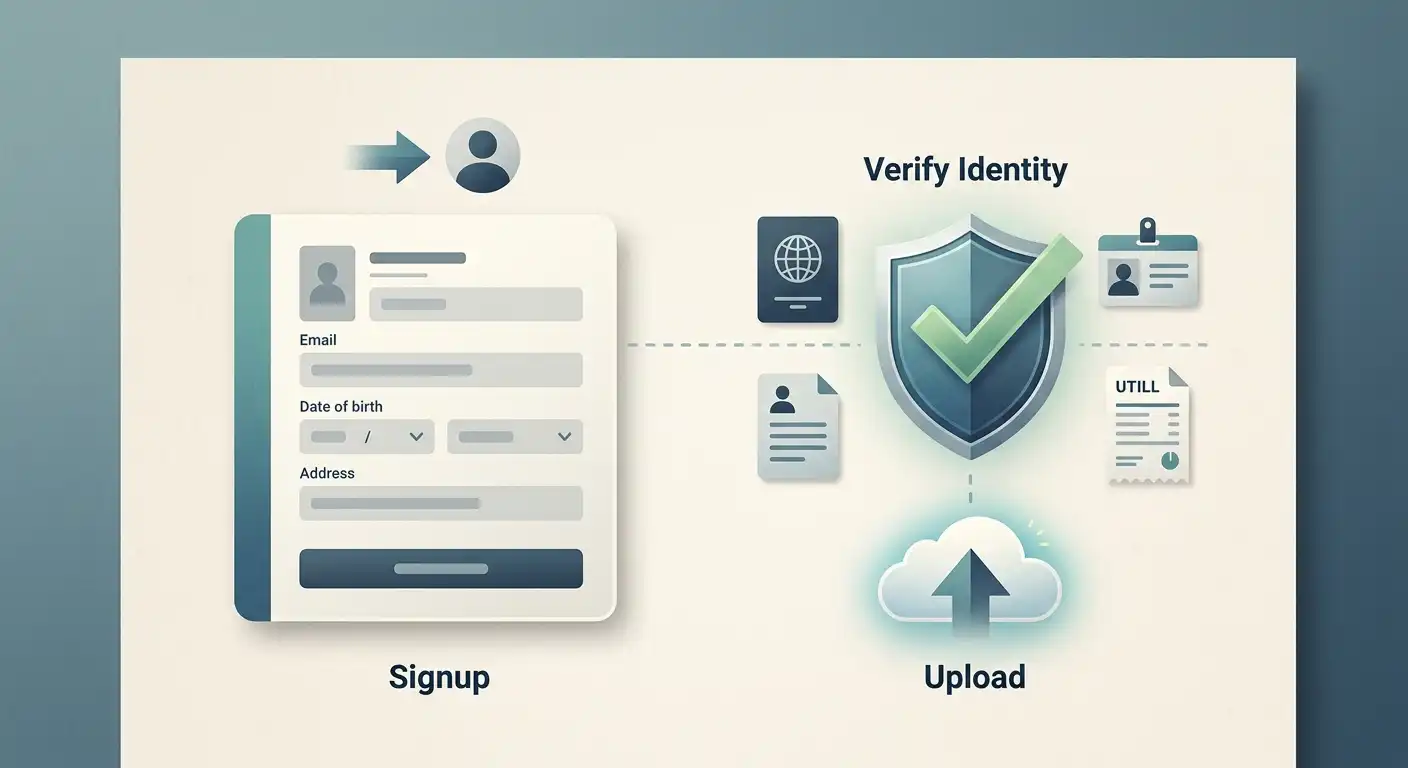
Real-money accounts can also require identity checks before a first withdrawal. A specialist review describes checks that may request identification and proof of address, and may include a photograph of the account holder holding identification. The precise documents and process depend on the operator’s terms. The practical point is that a displayed balance is not necessarily immediately payable: account verification may be a condition of receiving funds.
That condition is separate from free-play access. A demonstration that has no withdrawable balance has no cash-out to process, while a real-money account may need to satisfy identity and address requirements before funds are released. Where a free-play promotion is attached to an account, its terms should be read separately from the rules for ordinary deposited funds. One balance label should not be taken to mean every credit is treated alike.
Keeping the account name and personal details consistent with the documents submitted can help avoid a mismatch during verification. This is an account administration point, not a guarantee of approval or payment. The terms control what documents are accepted and what happens if a check is incomplete.
Deposit limits, loss limits and session time limits are tools for setting boundaries around gambling activity. Self-exclusion is another standard tool, designed to restrict access rather than manage a particular session. These controls concern money or time at risk; they do not change a pokie into a source of income or turn free-play results into a forecast.
BetStop applies to Australian-licensed operators and does not bind offshore sites. It should not be treated as a restriction that follows an account across every service. That distinction matters when assessing whether a particular control can actually apply to the account being used.
Free play can show how a game is presented, but it cannot establish what will happen after a deposit. Nor does a successful free-play session demonstrate that real-money play will reproduce the same result. The financial difference is concrete: deposited funds are at stake, account conditions govern their use, and verification may be required before a withdrawal. Free credits remain a separate matter unless the applicable terms give them a cash value.
A balance displayed after a winning spin is not necessarily an amount available to withdraw. The difference depends on the conditions attached to the money, particularly whether a bonus is active and how much wagering must be completed before the balance becomes cashable. The displayed figure is only one part of the calculation.
Each spin is decided separately by a Random Number Generator (RNG). A previous win does not make another win more or less likely, and a sequence of losses does not create a debt the game must repay. This is why a result cannot be treated as a forecast of what the next spin will return. A session can end with a win, a loss or a balance that is not yet eligible for withdrawal.
A wagering requirement, also called a turnover multiplier, sets the amount that must be bet before bonus-linked funds can be withdrawn. The terms should specify whether the multiplier applies to the bonus alone or to the deposit and bonus together. Those two calculation bases can produce very different turnover obligations from the same offer.
A specialist review uses a $500 bonus with a 40x requirement to illustrate the scale: the required turnover is $20,000 before winnings can be withdrawn. That is the amount wagered, not an amount guaranteed to be lost or won. The same review’s benchmark is to look for a requirement of 35x or lower; it describes anything above 40x as punishing. These are evaluative thresholds, not rules that determine the outcome of a spin.
The calculation changes when the terms apply the multiplier to the deposit plus the bonus. In the review’s example, a $500 deposit combined with a $500 bonus produces a $1,000 wagering base. At 35x, that means $35,000 in bets before the withdrawal condition is met. Reading only “35x” leaves out the most important input: the amount to which the multiplier applies.
Winnings earned while a wagering condition remains open may stay restricted until the required turnover is completed. Whether a particular bet counts, which games contribute to turnover and what happens if the condition is not met are matters for the offer terms. The headline bonus does not answer those questions; the calculation basis and eligible play do.
The arithmetic also says nothing about the likelihood of reaching the required turnover with a positive balance. RNG outcomes remain independent throughout the process. A player may meet a turnover target and have little or nothing left, or may retain winnings while still needing to satisfy the condition. Neither result can be inferred from the multiplier alone.
For a real-money pokies result, the useful distinction is therefore between three figures: the balance shown, the turnover still required and the amount eligible for withdrawal under the terms. If the offer does not state clearly whether the deposit is included, or how wagers count, the cash-out value cannot be calculated reliably from the advertised bonus. A large balance may look substantial; until the conditions are met, it may remain accounting rather than money available to collect.
A no-deposit bonus removes the initial payment condition; it does not necessarily remove the conditions on cashing out. Free spins can also produce a balance that remains subject to turnover rules or a maximum cash-out amount. The headline value is therefore not the amount available to withdraw.
A specialist review’s guidance treats a wagering requirement of 35x or less as a more manageable benchmark and describes anything above 40x as punishing. That is an assessment, not a market-wide rule. The offer’s own terms determine which figure applies and what balance it is multiplied by. A requirement can apply to the bonus alone or to the bonus plus another amount, so the calculation base matters as much as the multiplier.
Calculating Turnover
Identify the base
Determine if the wagering requirement applies to the bonus alone (e.g., $500) or the deposit plus bonus (e.g., $1,000).
Apply the multiplier
Multiply the base by the requirement (e.g., $1,000 base × 35x multiplier = $35,000 required turnover).
Check for caps
Review the terms for any maximum cash-out limits that may restrict the final withdrawable amount.
For scale, a specialist review gives the example of a $500 bonus with a 40x requirement: the required turnover is $20,000. If the requirement applies to a $500 deposit plus a $500 bonus at 35x, the turnover becomes $35,000. Those figures show why the multiplier cannot be read in isolation. They do not establish what any particular no-deposit offer requires.
For an offer with no deposit, the key question is which amount the turnover rule uses: the bonus, winnings from free spins, or another defined balance. If the terms do not state the base clearly, the eventual withdrawal calculation cannot be assessed from the advertised offer alone. A large promotional balance may therefore represent a large amount of required play, not a large cash entitlement.
Free-spin terms need a separate check. A specialist review notes that such offers may cap the winnings eligible for withdrawal. That cap can make the maximum cash-out lower than the balance shown after play. The relevant comparison is between the cap and the possible amount available after any wagering requirement, not the stated value of the spins.
PayID does not change these conditions. A deposit method describes how funds move; it does not establish the cash-out value of a promotion. An offer presented alongside real-money pokies in Australia remains subject to its written conditions, and the no-deposit label is not evidence that winnings are unrestricted.
The useful calculation is thus conditional: identify the turnover base, multiply it by the stated requirement, then check whether a separate cap limits the amount that can be withdrawn. If any of those terms is unclear, the advertised value cannot be treated as a reliable estimate of cash received.
A declined payment to an offshore gambling site may reflect a bank or card issuer’s controls, rather than a fault with the card. A specialist gambling-payment review reports that Australian banks and card companies are increasingly blocking transactions to known gambling sites. The scope of those controls can change, and a payment method shown on a site does not establish that a transaction will be accepted by an Australian financial institution.
A block is not a reason to keep retrying through different routes. Repeated attempts do not alter the legal position: the Interactive Gambling Act 2001 prohibits operators from providing real-money online casino games to people in Australia. A payment page’s availability does not make the underlying service locally licensed or create Australian recourse if a dispute arises.
Cards also carry a cost that may not appear in the deposit amount. A specialist gambling-payment review notes that a bank or card issuer may classify a gambling deposit as a cash advance. In that case, a fee of 3–5% may apply, and interest may start immediately. The final debit can therefore exceed the amount entered on the deposit screen, while interest may accrue before the card balance is cleared. The treatment depends on the issuer; the site’s description of a payment does not determine the card account’s treatment.
For a deposit of AU$100, a fee within that stated range would add AU$3 to AU$5, before any interest. That calculation is illustrative of the fee alone, not a promise that a particular issuer will apply it. The relevant cost is the amount charged by the card provider, not merely the amount credited to a gambling account.
Specialist gambling-payment reviews also describe Skrill and Neteller as popular for speed and relative anonymity. Those characteristics are not guarantees of acceptance, privacy from the provider, or protection against a blocked transaction. A bank transfer into a wallet, a wallet payment, and a card payment may each have separate account conditions and fees.
Before any gambling-related transaction, the useful comparison is between the amount requested, the amount actually debited, any issuer fee, and the interest treatment. If the bank blocks a payment, its decision should not be treated as a prompt to find another channel.
An app changes how an account is opened and accessed; it does not remove the account conditions attached to deposits or withdrawals. A real-money pokies app marketed to Australians is not made safer or legally protected by appearing in an app store or working on a phone. Australia has no licensed online casino, and real-money online casino games are prohibited services when offered to people in Australia.
Identity checks can determine whether a balance is withdrawable. A specialist review reports that casinos may require verification before the first withdrawal, including identity documents and proof of address; some may also request a selfie holding the identity document. These are account-level checks, not app-specific features. Account holders must complete identity and address verification before their first withdrawal, and the required documents should be checked against the operator’s terms before money is deposited. A mismatch between account details and documents can leave a payout unresolved.
Withdrawal caps are a separate calculation. A specialist review describes some casinos imposing weekly or monthly limits of $5,000–$10,000. Under those terms, a $50,000 jackpot would not be paid as one transfer: even at a $10,000 cap, it would take at least five capped instalments, while a lower cap would stretch the schedule further. The app interface may display a balance immediately, but the balance is not the same as cash received.
The useful comparison for any app is therefore the written payout rule: the cap period, the maximum amount released in that period, and whether the cap applies to all withdrawals or only certain account types. A large displayed win has limited practical value if the payout schedule is long or the operator disputes verification.
BetStop is a self-exclusion service for Australian-licensed operators; it does not bind offshore sites. Since no Australian-licensed online casino exists, its presence or absence in an app’s account process should not be treated as protection against offshore gambling. App access is an interface, not a change to the applicable safeguards or the terms governing a withdrawal.
A browser changes how a game is displayed and controlled; it does not make a spin more predictable. On a phone, a tap starts a round, but the result is still produced by a Random Number Generator. Each spin is separate from the one before it. A recent loss does not make a win more likely on the next turn, and a run of wins does not establish what the following spin will do.
That distinction matters when convenience is mistaken for an advantage. A compact screen, touch controls or the ability to open a game without installing an app concerns access, not the outcome process. Mobile use does not create a pattern in otherwise independent results. Nor does a browser session provide a basis for forecasting a particular result from previous spins.
Real-money play on a mobile browser also involves financial exposure, not merely a different screen. The interface can make it easy to continue, but ease of access is not evidence of improved odds or a dependable return. The relevant calculation remains the amount put at risk against an outcome that cannot be predicted spin by spin.
Responsible-gambling controls can help define boundaries around that exposure. Deposit limits set a ceiling on funds added; loss limits constrain losses; session time limits restrict time spent playing; and self-exclusion provides an option to stop access. These are controls on participation, not mechanisms for changing the Random Number Generator or improving the chance of a particular result.
A browser may make pokies reachable from a mobile device, but it does not alter the underlying mechanics. Any assessment of mobile real-money play should separate the convenience of the interface from the financial conditions of play and the randomness of each spin. The screen is smaller; the uncertainty is not.
A new label says nothing about the value or reliability of a real-money pokie service. In Australia, the legal position is more important than a launch date: the Interactive Gambling Act 2001 prohibits operators from offering online casino games, including pokies, to people in Australia, and no Australian online casino licences have been issued. A newly presented offshore site is not made locally licensed by being new, accepting PayID or displaying familiar payment options.
Where a service publishes terms, the useful information is contractual rather than promotional: which deposits qualify, how bonus conditions are calculated, what documents are needed for withdrawal, and whether payout limits or other restrictions apply. Those details should be assessed before money is deposited. PayID is a transfer method, not evidence of licensing, fairness or clear terms.
A specialist review suggests treating wagering requirements above 40x as punishing and looking for 35x or lower. These are that review’s benchmarks, not a guarantee that a promotion is worthwhile. The calculation depends on what amount the multiplier applies to; a headline bonus alone does not show the turnover required.
Identity checks can also affect whether winnings can be withdrawn. Before a first withdrawal, identity and address documents should be verified, with the possibility that further evidence will be requested. If the terms leave the verification process or withdrawal conditions unclear, the launch label does not resolve that uncertainty.
BetStop applies to Australian-licensed operators and does not bind offshore sites. Since there is no Australian-licensed online casino, it should not be treated as protection when assessing offshore real-money pokies.
A “PNG” label does not change the rules that apply when real-money pokies are offered to people in Australia. Under the Interactive Gambling Act 2001, operators cannot lawfully provide these services to Australian residents without a domestic licence, and no domestic online casino licences have been issued. The label alone therefore says nothing about whether an operator is authorised to serve people in Australia.
The distinction is between the operator’s conduct and the player’s position. The Act targets companies providing prohibited services, not individual players. Australians may legally play on offshore sites that accept them, but that does not make the service locally licensed or create Australian protections for the transaction. The operator’s location, branding or use of a PNG reference does not displace the Australian legal context.
That matters when considering claims about PNG online pokies for real money. A geographic label is not evidence of a licence, a regulator’s oversight, or a route to resolve a dispute in Australia. Nor does it establish where the company is incorporated or which rules govern its conduct. Those details require separate, reliable verification; the label itself is not a substitute.
The practical assessment is jurisdictional, not promotional: real-money online pokies offered to Australians remain within the scope of Australian law, regardless of the wording used to describe a site. Acceptance of Australian customers by an offshore operator does not convert it into an Australian-licensed casino. A PNG reference cannot supply a domestic licence where none exists, and it should not be read as a guarantee of local recourse.
Written by the editors at Norco Casino.